It was the 26th of December and we were air-bound, on route to the Senegalese Sine Delta with our two daughters (age 4 and age 6) and a group of friends (a total of 9 adults and 9 children, the youngest in the group was just under 2). The plan was to spend a bit of time with friends living in Dakar before driving south along the coastline to a natural reserve.
In addition to soaking up some sun and adventure, our hope was that our girls would come away from this experience with a bit of perspective about the world they live in. That they would form an emotional attachment to new surroundings, new people, new culture and, fingers crossed, the trip would rid them of any pre-existing stereotypes about the African continent already wedged inside their tiny heads.
On the flight over, the girls could not stop giggling and squirming in their seats—their little bottoms swaying from one side to the other, heads flopping in every direction, annoying the passengers seated in front of them by repeatedly opening and closing the latch of their folding table.
– What are they going to bring us to eat, Mummy? My 6-year old daughter asks, her face smeared in anxiety.
– You’ll like it, I think it’s a pasta of some sort. I respond.
– I want mine plain, please—ok? No sauce, mum, ok? Mummy did you hear me? Please NO sauce!
– I imagine it will come with sauce and there is nothing I can do about that. Please remember that this is the only meal you will have for many hours so do your best to eat, otherwise you’ll be very hungry later.
– ANNNND!!! Interjects my just-turned-4 year old, there is NO food in Africa when we get there!
– Of course there will be food in Africa, girls. I say.
– No mummy, I know about this. There is no food and there is no water in Africa. The children are hungry there. I learned about it in school. Reconfirms my youngest.
– Yes my love, you are right that there are many hungry children in Africa. There many hungry children all over the world—even in London. The problem isn’t that there is no food available though, it’s that some people in the world can’t afford to buy or grow food. We are fortunate because we do have money to buy food in London and we will also be able to buy food in Senegal. Still, it will be a long time till we get to Sengeal, so both of you make sure you eat up your meal when it comes.
– No mummy, you just don’t understand. I REALLY know about Africa.
The food arrives, we open the cutlery and everything smells delicious. The friendly flight attendant offers me a glass of champagne and I decide that I will fly Air France whenever possible as it is the only airline I’ve come across that serves up Champagne to the masses in Economy.
When I look over at the girls, they are staring, eyes wide, at the food before them completely distraught at the sight of a sauce they’ve never seen before.
You will eat. I say sternly and turn back to my own meal.
A good 10 minutes later and 99% of the pasta is still in their dish. I glare at them, eyebrow raised, and the tears begin to well up in my eldest’s eyes. I tried it, Mummy (sniffle sniffle) but I really didn’t like it. I ate the bread and the fruit and I’m full now anyway. I promise I won’t be hungry later.
Few things annoy me (and most people I know) more than wasting food.
Hmmm. Maybe I should throw that starving children argument right back at them. Or better yet, maybe I’ll take them to some Senegalese orphanage when we arrive—then they’ll know what it’s like not to have food–even parents for that matter! Then they’ll know better than to cry over tomato sauce. Spoiled little brats.
As long as you at least try the pasta sauce, I say instead.
I remind them one more time that there is no other meal for the remainder of the trip. The trays are collected and the lovely hostess pours me a cup of coffee.
But no more than 30 minutes go by before the whining begins.
Mummy, I’m hungry. My tummy hurts. Did you hear me, really Mummy, I’m starving. Mummy, mummy? Please, Mummy, can I have a snack? MUMMMY!!!!
I remind them of what I said earlier and do my best to ignore them. We had already eaten all the snacks I had brought and I really had nothing for them. After nearly an hour of listening to extremely high-pitched whining, the people in front of us, desperate for them to shut up, turn around and hand the girls each a bag of treats.
I admit I was quite relieved.
They stuffed their mouths as if they had never tasted sugar before and instantly began bargaining with one another.
– Can I have some of your Smarties?
– No, you have your own treats.
– Pleeeeease. I don’t have Smarties in my bag and I know they don’t have Smarties in Africa!
We arrive in Dakar at night. The girls stare out the window of our airport taxi but given the sparse street lighting along the road, there isn’t too much to see.
But then my youngest (her name is Luna) suddenly screams and points her finger upward out the window.
The moon, the moon, my moon—its here! It followed us all the way to Senegal!
The first similarity between Senegal and England is identified.
We share the same moon.
We spend the first day exploring a bit of the city (with the children) and that night we spend dancing till very late at a club (without the children) to an eclectic mix of hiphop-reggae-afrocuban-jazz, alongside stunning long-legged Senegalese women. I was told later that most (if not all) the women in this particular club were prostitutes. I was surprised to learn that prostitution is legal for any woman over 21 who registers with the police and the sex tourism industry apparently goes both ways, with middle-age white women from abroad also engaging with local men for hire.
The second morning we woke to the bluest of skies and the sound of gentle waves rocking the small fishing boats scattered around our beach cove. Our hotel faced the sea but the bustling energy of the city behind our hotel added steadfast rhythm to the beach life.

Dakar
It is important to note that the grownups in our group were well aware of the situation unfolding in the Central African Republic and Mali when we arrived and our hosts spent a great deal of time bringing us up to speed on the largely uncovered news of the entire Region. Surprisingly though, despite overhearing some of our adult conversations and despite the incredibly gruesome images shown on the television in the lounge of our hotel, the children seemed oblivious to the conflicts unfolding in the belt of fire that surrounds Senegal—Mauritania to the north, Mali to the east, Guinea and Guinea-Bissau to the south, and Senegal basically surrounds the Gambia.
Still, I couldn’t help but wonder how a conversation might unfold if by chance the children were to look up from their breakfast croissants piled high with Nutella to notice the bloodshed ravaging above their heads.
— What’s happening on the television, Mummy? Is that real? Where is that—is it in Senegal?
— Yes, unfortunately it is very real. But no, that isn’t Senegal. In Senegal things are quite peaceful.
– What’s peaceful?
— When people aren’t trying to hurt one another.
— Why are they hurting people in the television?
Perhaps the best entry point to a discussion could be to talk about what sets Senegal apart from the other countries—political stability, peaceful social interactions, no sort of extremist religious movements.
— What does “extremist” mean?
— It’s when you don’t accept that other people have a God that looks slightly different from your God.
— But I thought you said that we can’t see God with our eyes, only with our heart?
— Some people find it difficult to see God with their hearts and rely only on the eyes—eyes are not as wise as the heart.
The kids never asked any questions but I was curious.
I learned that in Senegal religious diversity is an integral part society. Most Senegalese Muslims are Sunni and follow the Sufi religious traditions, which focuses the individual on what the Prophet Mohammed called the greater Jihad—the personal struggle within each of us as human beings for inner peace and reflection. Catholics make up 5% of the population and there are other Christians living side-by-side Muslims in harmony. It doesn’t seem to matter what religious denomination you adhere to in Senegal but what is clear is that everyone must be a believer—atheism is not socially acceptable.
Another factor that may contribute to the peaceful nature of the country is racial equality. Even though Senegal has a diverse set of ethnic groups everyone here is sub-Saharan and dark-skinned. Racial tensions exist in places like Mauritania where the dominant moors, who have their ethnic roots in northern Africa, exclude dark-skinned members of their population and in Mali, where the Berber and north-Saharan populations of the northern Azawad region seek independence from the sub-Saharan government in Bamako.
This is not to say that Senegal has been completely immune to conflict. In the Casamance region of the country a low-level civil war has been going on since 1982 over the question of independence between the government and the Movement of Democratic Forces of Casamance (MFDC). However, this conflict has largely been calmed since the President Macky Sall was elected to office in April 2012. There was also the Mauritania-Sengalese border conflict over grazing rights in the fertile Senegal River valley that began in 1989 and left some 250,000 people displaced on both sides of the border. Between 2008 and 2012, with the help of the UNHCR, most of these refugees have since been repatriated but it is believed that the Mauritanian government took advantage of the repatriation to systematically rid their country of black Mauritanian citizens.
Modern Senegal has always been occupied by various ethnic groups. Some of its kingdoms date back to the 7th century. But unlike neighbouring countries, the empire was built up as a voluntary confederacy of various states rather than an empire built on military conquest and the country has a long tradition of political institutions comparable to that of European states. Léopold Sédar Senghor, Senegal’s first president, was a great intellectual—a poet nominated for a Nobel Prize—who establish a solid democratic foundation and sense of cultural pride. One of his most famous poems begins:
Naked woman, black woman
Clothed with your colour which is life,
With your form which is beauty!
In your shadow I have grown up; the
gentleness of your hands was laid over
my eyes…
Although Sedar Senghor did rule for 20 odd years, he voluntarily stepped down from power and ever since Senegal has enjoyed free elections and peaceful transitions between presidents. There hasn’t been a single coup d-etat in the country’s history.
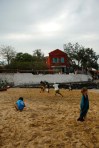
The following day, we take the children to explore the beautiful little Island of Goree.
Goree
Goree was one of the first places in Africa to be settled by Europeans and is most known as the location of the House of Slaves, which we visited (without the children).
While our little ones played on the beach carefree, we listened to the curator of the slave museum as he pointed to the “door of no return”—an open door at the far end of the slave quarters with a stunning view over the Atlantic. Apparently, after passing through this door, slaves carrying a weight of 17kilos chained around their neck, either boarded slave ships on route to America or threw themselves into the shark-infested waters below. There is some historical controversy around the exact on-goings of the slave trade in this particular house, but without a doubt the door-of-no-return remains an extraordinary symbol of the horrors of slavery.
As I walked around the claustrophobic quarters, the sound of the curator’s voice echoing inside the walls of torture, I couldn’t help but think of my girls. I wondered whether my 6-year old might already be familiar with the word “slave.” In the United States children begin to learn about slavery at a conceptual level as early as pre-kindergarten (age 4.5) but in the UK they start at around age 9. I also wondered at what age local children on the island understood their history and how this history was explained to them. My heart raced and stomach turned as I tried to consider how I might start to explain it all to mine.
Girls, you know all those children you’re playing with on the beach? Well a long time ago, white people like us, stole their mothers and fathers, locked them up in dungeons with chains around their necks. We packed them as tightly as possible into these small cave-like spaces. We measured their breasts and penises to determine the best price for them because back then we believed big breasts and penises would create better slave-babies. We then took these mothers and fathers and put them on ships to America, where they would continue to live as slaves to the American white people. I know it’s hard to understand, but for some crazy reason we were unable to see that the black people of Africa were just the same as us. I know it’s very sad, but we haven’t always been able to see with our hearts and minds.
-Mummy, for how long were we unable to see with our hearts and minds?
– I’m sad to say, we were blind for nearly 300 years.
No way. I couldn’t do this. I couldn’t have this conversation yet. I left the museum in a panic. I ran to the beach and comforted myself with a bottle of Coke. Then I watched as my children jumped waves with their friends, in awe of the local boys diving off the nearby dock. The only colour they registered in their mind was the hot pink bougainvillea growing everywhere.
They have bougainvillea in Senegal just like the bougainvillea growing on Omi’s house in Mexico! Second similarity between Senegal and Mexico is identified.
We share the same flowers.
On the third day, we pile into our beat-up Korean Pinto and embark on the five-hour drive along the coast to the Sine Naussean Delta. A caravan of four cars. The traffic chaos leaving Dakar was fabulous (although I was grateful that my husband was driving and happy to be in a car that had already looked as though it had been in a number of minor accidents.)
As we inched—jerked—along the slow-moving highway we grew thirsty but given the multitude of people weaving between the cars on foot, selling fresh fruit (nuts and phone cards) we were able to fill our bellies with juicy oranges. Not one person knocked on our car window to ask for money. People were only eager to sell.
– Mummy, I wish we had people selling fresh oranges in London when we’re stuck in traffic.
– Yes, that would be fun wouldn’t it?
After 2.5 hours of driving we pull up to a pizza joint. Yes, pizza in Senegal—it does exist. Although, the pizza margarita is a bit spicier in Senegal than in London, our hungry daughters learn how to sip water with every bite. Note that this was the only pizza we ate over the two-week period. The rest of the time the kids ate fresh grilled fish and rice, which they loved.
After the pizza, we turned off the paved road; it had more potholes than the salt flats so we took the off road option. The expanding landscape of sand and salt along our coastal drive, dotted with enormous Baobab trees and white African cows, was something otherworldly. There were a few villages scattered along the way and occasional barefoot, happy children playing in the sand, waving at our girls as they hung out the window.
At one point–maybe a couple of times, our cars got a bit stuck in the sand but we managed to push them out without too much difficulty.
– Put some muscle in it, Daddy! Come on!
– Weeeeeeeeeeeee!
– Lets do that again! Let’s get stuck again, Daddy, pleeeease!
Many of the villages we passed along the way contained traditional thatched-roofed homes built in large circles, all facing each other.
– Look girls, what can you tell me about these houses that are different from the houses in England?
– Uhhhhhhhh. Hmmmmmm. I dont know.
– Oh come on, look at the roofs of the houses, what are they made of?
– Straw? We’ve seen that before—they have straw roofs in England.
– What about how the homes are placed all facing each other?
– Yes, just like when we go camping.
– I guess it is.
So no big deal obviously. For every difference I could identify between our two countries, our two continents, the children retorted only with what they found similar or familiar; and if something was ever different, it was only because it was better.
Like the tree house where we slept for the following five nights at our eco-hotel. It was built high up in a Baobab tree, nestled perfectly between three strong branches, each at least a metre in diameter. From the terrace of our magical house, which was literally covered in hot pink and yellow bougainvillea, we had a view of the endless stretch of the Sine Saloum National Park.
– Mummy, why can’t we live in a big tree house in London?
– Believe me, my love, I wish we could live in a tree house sometimes just as much as you do.
sine saloum delta
Our group of 9 grown ups and 9 children brought in the New Year dancing along side villagers who came to perform at our hotel. The children all loved dancing with us and unlike the grownups, the children had little difficulty getting the rhythm right.
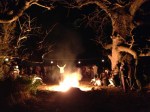
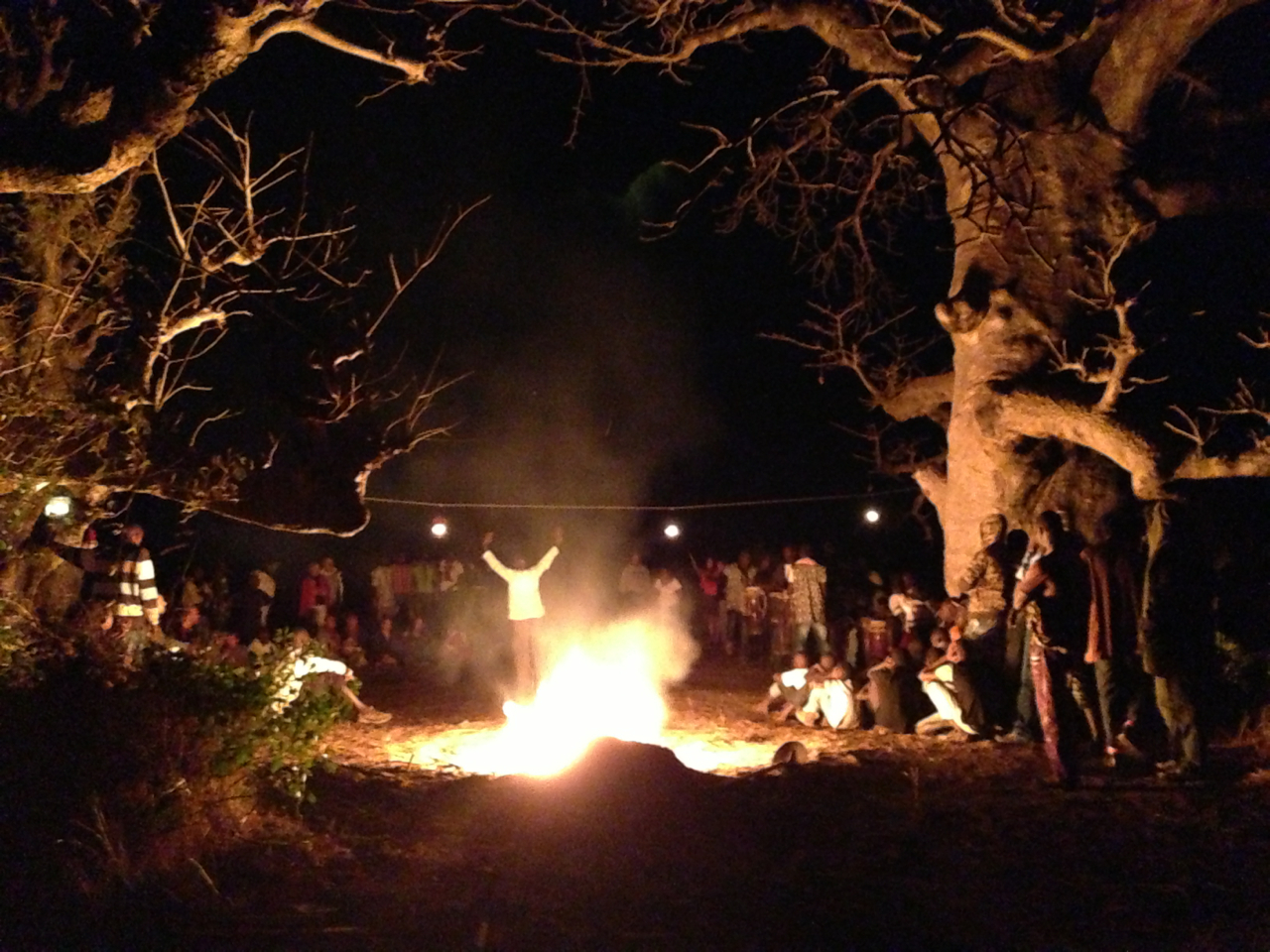
Later that evening, after the little ones were tucked sweetly into bed, some of us ventured off under the moonlight on donkey-drawn carts that took us across the vast delta to a spot where virtually the entire village had gathered around a roaring fire in the middle of two enormous Baobabs. We were there to watch an international wrestling competition (known as Laamb) and one of the villagers was competing against a wrestler from Mali so we had someone to root for. The wrestlers, dressed only in a loincloth, took to battle in the sand with a fury of drumming and chanting all around them. There were occasional outbreaks of uncontrollable dancing among a crowd of around 80 people and even the wrestlers danced between their matches.
senegalese wrestling
It was a magnificent experience and privilege. Did I mention the moon was also out in all its glory?
It was also particularly emotional for me because the 31st of December coincides with the night my husband and I were married. And to my extreme surprise, my husband (who by the end of all the wresting merriment was saturated in the adrenalin) decided to step into the middle of the dancing circle and announce to the entire village that it was our anniversary. This was extremely touching and romantic until the crowd forced us into the dancing ring–at that point my husband and I managed to scare even the wrestlers with our moves.
I am sure that if our daughters had seen the effect that Senegal had on their father that New Years night, they would never had allowed us to leave.
Funny enough, despite the fact that our children didn’t ask us if we could move to Senegal permanently, my husband and I still discussed the possibility. Prior to moving to London, he and I both spent much of our lives living in the lesser-developed parts of the world, so we would not be unversed in making a life for our selves in such a place. And besides the overwhelming sense of freedom that comes with living in parts of the world where rules are less formal, there is always lots of inspiring work to do.
Speaking of work to do, there was one difference that the children noticed and pointed out to us on our journey across Senegal. It was the litter in and around virtually all the small towns we visited.
– Mummy, why are there so many blue plastic bags everywhere? Why don’t the people just pick up the bags and put them in the bin?
– Do you see any bins around?
– No. But you would need a LOT of bins for all these plastic bags.
– You are so right. There is a rubbish problem in many African countries, particularly because of the number of plastic bags. The problem is that lots of people here get their clean drinking water in plastic bags. People also use plastic bags to poo in sometimes when there is no bathroom nearby.
-To POO IN!??!!!??
– Well we have toilets in our home in London and when we use them, the pipes carry our waste to a proper place. Not everyone in the world has access to toilets like we do.
2 minutes go by…
– Yes, in London we get our water in plastic bottles but not in bags, right Mummy?
– Yes, you’re right, we do get some of our water in plastic bottles–far too often. We get most of our water from the tap, but we also use far too much plastic. We actually use much more plastic (whether its bags, bottles, wrapping) than they do here in Africa. I guess you could say that we are better at collecting and hiding our rubbish. That’s why you don’t see it as much.
– I’m not a litter-bug, Mummy.
– No, you’re not.
I didn’t tell them that only 10% of rubbish in Africa ever makes it to proper legal dumping areas–90% is left to rot in communities or burned in acrid bonfires. Plastic bags are just a fraction of the overall waste problem but they are nonetheless a serious eyesore against the otherwise serene landscape. Some countries have taken steps to ban and/or tax plastic bags but additional creative solutions to deal with problem are clearly needed.
5 minutes go by…
– Mummy, how does our rubbish in London get hidden?
(Shit)
– Well actually, lots of our rubbish is sent to China and other parts of the world for recycling.
– Why?
(Shit. Shit.)
– You ask very good questions, my love. The truth is rubbish isn’t just a problem in Africa. It is a problem for everyone in the world.
Nearly 70% of plastics in the UK are shipped to the Far East. About a month prior to our holiday in Senegal I had read an article in the Telegraph explaining how China had actually refused to take in 17 containers of British rubbish (420 tons of plastic) because it was contaminated. Apparently, the Chinese are introducing tougher regulations and now refuse to accept unwashed plastic and unsorted recycling. I wonder how successful waste management in Europe and the United States would be without China and other Asian countries available to absorb the extraordinary amount of both legal and illegal waste shipments.
Our car ride back to Dakar was bumpy but sunny and filled with great conversation, the kind of conversation that only comes from stepping away from the everydayness of life in London.
We could have stayed another week, or month, or even years, but only if we could carve out the right job. And while there is always a lot to do in places like Senegal there is actually a lot to do everywhere.
The mission of this trip was to broaden our children’s perspective of Africa. Did they build an attachment to a new place, new culture, new people? Absolutely. Are the concerned about poverty in Senegal? NOt in the slightest. As far as they were concerned, every child they played with on the beach was at least as happy as the ones back home.
Did they eat their airplane food on the way home? Of course not. It still had sauce on it.


 Girlwithoutawatch