Relativity: Memory, Truth and Immortality

1 11 2010

Author: Girlwithoutawatch

Memory

Ten years ago, I didn’t own a mobile phone. I didn’t own a phone book either, or perhaps I did, but it was always lost. None of this mattered, however, because back then I was capable of storing everyone’s telephone number in my head. In fact, I can still provide you with the phone numbers of dozens of friends from university, dozens from secondary school, even—if not especially—the phone numbers of most of my classmates from primary school.  Today, however, ten years after I bought my first mobile phone, I cannot tell you what my husband’s work number is.  I made a point to memorise his mobile number—more than anything in case of an emergency—but this was no easy task.  I am not alone in losing the skill of memorising telephone numbers; most people I know are unable to recall a telephone number an rely entirely on their mobiles, blackberries, iPods, Google, Yahoo and/or Outlook-address books.

So recently—after downloading the guzumptinth video of my daughters playing together—I got to thinking that much in the same that we are losing our capacity to use our brains to store phone numbers, we may (in the not too distant future) lose our capacity to remember events, places and even people without the assistance of our digital memory-bank of photos and videos.

Just yesterday, for example, I wanted to take my eldest daughter to meet up with a friend and her 3-year-old son, Alex.  The two children had met before, but time had passed since they last played together. When I told my daughter who we were going to see it was clear that she was struggling to recall the boy, and she became a bit anxious about meeting him.  So in order to get her to feel a bit more enthusiastic, I showed her a video I had made months back of the two of them playing happily.  We watched the video twice, clarifying a few details each time (such as the name of the park where we had played).  This was all it took for my daughter to put on her favourite party dress and sparkly shoes and to hurry me out the door.

It is unclear to me whether the video served to “trigger” an existing memory that had been stored but was too difficult to recall on its own, to “recover” a memory that had been lost or if this video actually served to “create” a memory that otherwise would never have existed.

But surely, it is obvious that the technological ease with which we are able to record the precious moment of our lives will begin to play havoc with our capacity to remember these moments unaided—or at least to remember them in the same way we do now.  I believe it is just a matter of time that our brains, or rather our children’s brains, will find it unnecessary to exert themselves in this way because it will become much more efficient, not to mention accurate, to have everything stored in a cyber-memory-cloud rather than in our own heads.

Truth

I love telling stories of past experiences.  Every time I tell one of my stories it seems to get better, interjected by slight exaggerations here and there, uniquely edited depending on the audience.  But the best of these stories tend to be those that have no real record of their happening at all. The ones that have no photographic proof, no video proof, no written proof of ever having occurred—they are most certainly the pre-email, pre-Facebook, pre-twitter, pre any real-time recording of what I was truly feeling and experiencing at that time.  So if I recall the story and describe the scenery at the time as hot and sunny, there is no image of rain to contradict me.  And if I describe myself as having been single at the time, there is no record to show that I was in a committed relationship.  I guess what I am suggesting is that in the future, stories such as these will become analogous to myth, and I will be viewed as an old-fashioned story teller.

Is this a bad thing? Not necessarily.  It is simply another reflection of our pursuit of truth.

Our children will be able to access the cyber data-base filled with endless amounts of video, photographic and written records of anyone they are curious about and, inevitably they will be able to then make a more informed assessment of who these people really are/were–their personality, achievements, values, beliefs, practices (whether it be a romantic interest, a distant relative, a potential work-hire, a local neighbour).

I believe these videos recordings (and the other cues and situations that induce awareness of the self such as mirrors or having an audience) not only increase the accuracy of our personal memory but they also help to make our children more self-aware.  Most of us can probably remember disliking the first time we heard the sound of our own voice played on a recording device.  I know that I felt extremely awkward the first time I watched a video of myself.  This has decreased with the appearances I make in the video footage of my children but I am still uncomfortable with it at some level.  The person before me continues to seem so different from the person I tend to think that I am (the voice is different, the gestures are different, my overall tone and body language does not completely match my own perception).  Fortunately, our children will not experience such awkwardness.  They will have grown up being fully aware of what they look and sound like—accustomed to short video clips of them doing anything from eating peas, spilling paint all over themselves, prancing around in a tutu, opening up gifts.  This will lead them to become self-aware much earlier in their childhood.  It will help them to gain a greater degree of control over how they are operating in the present, instead of reacting to something conditioned by their past. It will help them to become better communicators, improve their social skills, have greater empathy, and to ultimately be better decision-makers through a more objective evaluation of themselves.  A series of recent studies showed that self-awareness improves processing efficiency functions, such as working memory, processing speed and reasoning (Demetriou & Kazi, 2006).

Some say that when we fail to take the time to sort through those videos/ photos that are most important to us today, we are doing our future generations a disservice; that we are simply filling them with unprocessed, raw data that is not a true representation of who we are—i.e. the fact that we fail to weed through and select the “best” photos in our digital libraries, or that we don’t take the time to make photo albums or create quality edited films out of the thousands of short video clips stored on our hard drives.  But even if we are leaving it to others to sort through, I think there is value to be gained from our future generations deciding what is relevant to them, based on whatever it is that they are interested in finding—based on the truth they are searching to understand and to express by surveying, sorting through, and analysing all our rich multi-media data-base.

Besides, future generations will certainly have improved capabilities in data search, processing and analytics software.  When I was an undergrad, the LexisNexis archive database was all the rage—it allowed us to search full-text stories for key words, numerous articles on a specific topic, name or slogan that previously could have only been found by many months in the library, in just minutes. Fifteen years later and I honestly barely stepped foot in my university library whilst writing up my PhD dissertation: Almost all the information I needed, I could access without leaving my desk/computer.  Having more information in itself should not necessarily make life more difficult because we will also become more efficient at processing this information.

The exponential rate with which our information content (i.e. multi-media reporting, personal photo and video libraries, blogs, email correspondence, Facebook ‘status’ updates, tweets) and our information technology are advancing is a beautiful trend.  It is a quest to exchange information not only from continent to continent, and from private to public, but from past to future.  Our lives will ultimately be represented more truthfully and we will therefore be better understood to future generations.  Only good things can happen from a history better understood.

Immortality

Okay so now, imagine having the technology used to film Avatar in a video camera the size of your Flip.

Imagine your children showing their children 3D-video footage of you reading a story and tucking them into bed, long after you’ve passed away.  These images of you will be so life-like that your grandchildren will feel almost as though you are sitting next them, reading them those stories.  Perhaps in this regard, we should be doing a bit more to preserve the immortality of our own parents.   For example—making more of an effort to turn our fabulous technology away from our children who are smothered in their own personal reality-TV shows anyway.  And/or perhaps we should create more recordings of us interacting with our children as well.

I think that this is what our children will want more than anything 20 years from now.  And because their own memories will most likely not function in the way that ours do today, they will be more dependent on such recordings.  And maybe, just maybe, this is our ticket to eternal youth too.


Economics–Calling All Mothers

14 10 2010

Author: girlwithoutawatch

For the better part of the last century we’ve been trapped by two economic ideological forces and much like the political factions that govern our society, these forces have often served to polarize, even radicalize our beliefs, rather than help to find any common ground. Until the late 1990’s you were either a capitalist or a communist, you either believed in the individual or the state, you either trusted in the market or you were naive.

It has only been in the last decade or so that the true multidisciplinary nature of economics has finally woken up the contributions made by anthropologists, sociologists and political scientists.  Oliver Williamson and Elinor Ostrom, the two Nobel prize winners for economics this year, were recognised largely because of this growing trend in more creative economic thinking.  Ostrom’s work focuses on the study of common pool resources–in particular, how humans interact with ecosystems to maintain long-term sustainable resource yields (common pool resources include many forests, fisheries, oil fields, grazing lands, and irrigation systems). Both Williamson and Ostrom consider the effects of institutional arrangements—(while Williamson focuses on the transaction costs that arise from these institutional arrangements, Ostrom focuses on social-ecological impact of such arrangements).  Institutional arrangements include a combination of the formal rules (laws, regulations, contracts) and the informal rules (culture, values, traditions, social norms and pressures) that encapsulate our society. Incorporating greater understanding of the role of these institutional arrangements provides a more holistic and nuanced application of economic analysis on the role of incentives, institutions and behaviour, as well as a common link in understanding between traditional economists and other social scientists.

What does all this mean for us as mothers, especially those of us with no background in economics, political science or sociology? As mothers we have access to a great deal of critical information and material—cognitive data based on what we observe in the behaviour of our children (and perhaps our partners too), household consumption patterns, resource access and productivity, as well as a closer understanding of the ways formal and informal institutions operate and the community level (local neighbourhood, schools, health care facilities and our social networks). As mothers, we are at the forefront of understanding first hand that people’s choices and behaviours are conditioned not only by their own preferences and budget constraints, but also by social and cultural forces, moral influences, information asymmetry, media bias, manipulation by pressure groups and hierarchical perceptions of power.

You don’t have to be an economist to have something to say about economics. Running a household, especially households filled with children, makes you a practice the art of economics every day.  Data from your average everydayness, can provide additional information regarding those core elements that make us human, as well as those core elements that make us happy: what makes us tick, what motivates us, what influences us, what drives us, what are our true preferences and exactly how volatile do they seem to be?  We can learn through our children what our intrinsic human needs are—we can unravel the ways in which our raw (state of nature) interests and incentives develop—which are innate and which are learned—how we compete for affection—how we compete for survival? As mothers we are aware of the fact that our children can often act irrationally.  Well, behavioural economists for example, incorporate the ways in which we are often influenced by irrational tendencies. Irrational behaviours of individuals include taking offense or becoming angry about a situation that has not yet occurred, expressing emotions exaggeratedly (such as crying hysterically), maintaining unrealistic expectations, engaging in irresponsible conduct such as problem intoxication, disorganization, or extravagance, and falling victim to confidence tricks.

Try to explore the influences that informal institutions (values, customs, traditions, norms) and formal institutions (rules, regulations, laws) have on the choices you and your children make every day.  And if you haven’t done so already, begin to interpret the behaviour of your children in the context of improving upon the economic system that cradles the society in which we live.  Through this collective act and through our writing, questioning, debating, we will surely come up with the creative insights and out of the box thinking that our children are entitled to.


Happiness – A Man In His Prime

30 08 2010

Author: girlwithoutawatch

My husband turned 40 this year. So too did a bunch of our friends. Many threw hip parties in bars/restaurants, some hosted us them in exotic destinations abroad and some enjoyed quite more intimate dinners at home.  Although for the most part, the general mood at these events was relaxed and celebratory, some of the conversations I overheard among a number of my male friends made me think that perhaps there was a bit of melancholy in the air as well.  On a few of these occasions a particular question was raised that I found quite interesting and indicative of the mood of our peer group:

“What is—or rather, how would we define—a man in his prime?”

[Please forget for a moment, the fact that there is no such translatable term for a “woman” in her prime—and if there were, please forgive the fact that most men might suggest that these would be our early 20s years.”]

On one of these occasions, I suggested that a man in his prime is simply a “happy and contented” man.  As might be expected, this fomented a fierce debate over the varying ways in which each of us define happiness.  For one of my girlfriends (an artist), who has a super Zen-like personality (always seemingly content with where she is now), happiness equaled security and safety, in knowing that things would at least be as good as they are at this moment because in her opinion, she had a happy home, with two amazing children, she felt free to make choices based on a range of preferences (schools, medical care, food, travel, material items, etc.), and she was still very much attracted to her husband.

For her husband (an entrepreneur) on the other hand—happiness meant being able to continue to take on risk.  Quite the opposite of his wife, he equated risk with freedom; having such freedom made him happy.  In an ideal world, his confidence, gut instinct, creativity and experience, would allow him to continue to take on risk and this in turn would allow him upward economic mobility.  But there was never a guarantee that this would happen and in the past there had been some less successful endeavors.  So this friend, now at age 40, felt he was at a crossroads of sorts—the entrepreneurial spirit in him wanted to leave his current job to pursue something more fulfilling but the current job offered the financial security he and his family had grown accustomed.

For my husband, happiness meant having just enough financial security to be able to eventually change course or direction and pursue more risky, but potentially less profitable professional interests. Of course, exactly what that magic monetary number would be in order to provide “just enough” of a nest egg was absent from his answer.

And then there was me, who felt that the concept of having enough financial security was a constantly moving target, most likely weighted against the financial security that we observe among our peer group—and this measure would invariably limit our mobility and freedom.  From my perspective, we couldn’t rely on financial security alone as the stepping-stone to doing something more fulfilling—to finding greater happiness.

Most people would probably agree that the period in which a person begins to think about the notion of a man in his prime is somewhere towards the middle of ones working life—early 40s (approximately 20 years into ones career and 20 or so years before retirement).  It is during this period of one’s life that we begin to reflect on our achievements to date.  For most men I know, the weight of this achievement rests primarily upon financial successes in the work place.  And these career successes (or failures) invariably factor into their happiness equation.

Perhaps this is partly to do with the fact that men don’t seem to derive their confidence from achievements made in their private sphere in the same way that many women do.  Relative to women, men certainly don’t talk about the intimacies of their private lives—the unique relationships they have with their partners and/or children, the way in which they might successfully manage some household tasks.  My husband certainly relies almost exclusively on me for intimate information about our friends, which I acquire from evenings out alone with the wives.

Without the proper space to discuss achievements made in the private sphere, men are limited to talking or observing each other’s achievements in the public sphere alone. And up until this point in their lives, the public sphere is dominated by work-related discussions.  Women do not suffer from this issue to the same extent, in part because we have more freedom to observe each other’s achievements in the private as well as the public sphere—in fact, I often know very little about what many of my female friends do professionally because we tend to discuss our private lives with much more readiness, especially post children.

To help deal with this 40-something complex, I think it could help to split the way we perceive our lives into three phases:

The first phase beginning at birth and running through to the start of our career—we spend this period of time simply learning about ourselves and shaping our individual identities.  The second phase, say first twenty years of our working/career life, we spend building the infrastructure to support the aforementioned identity we developed during the first phase.  Then in the third phase, we would ideally use that identity (our interests, personality, spirit) and our infrastructure (information, wisdom, skills, access, social capital as well as financial capital) to influence things that lie beyond our immediate household.

This third phase basically involves more than taking on a new (“selfish”) hobby.  It means choosing to do something that is not driven by monetary gains alone.  I believe “a man in his prime”—or a woman in her prime for that matter—is someone who has been liberated from this stereotypical role of financial provider (or at least financial provider alone).  For this to happen, it is critical that we first factor in the range of variables that make up the quality of ones life at the household level, rather than the overall economic worth of the household, to help us become happier with where we are today, right now.  But figuring out how to use our skills to influence at least some aspect of the world around us, outside the our traditional work place, will make us feel part of something greater, more self-less; and this will inevitably help make us happier with where we are going and more connected to our future.  No time you say for all this?  Hogwash.  The more you do the more you do.


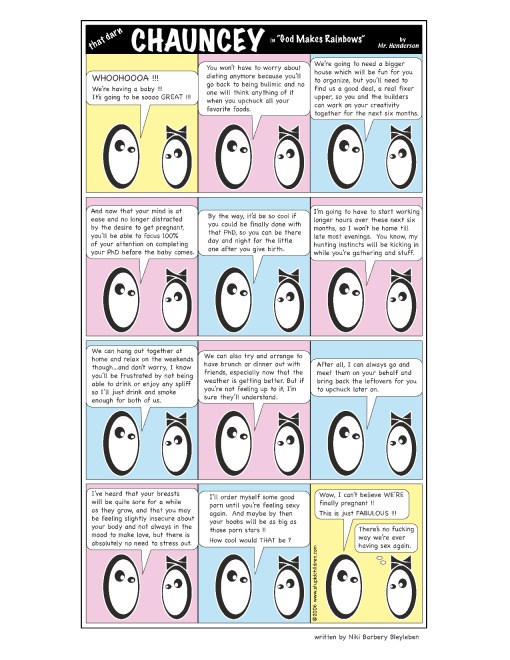
Love – God makes rainbows

15 03 2010

Love-god makes rainbows_jpg


Morality – Drugging the Cleaner (Part 1)

23 01 2010
Author: girlwithoutawatch
 
Not like the brazen giant of Greek fame,
With conquering limbs astride from land to land;
Here at our sea-washed, sunset gates shall stand
A mighty woman with a torch, whose flame
Is the imprisoned lightning, and her name
Mother of Exiles. From her beacon-hand
Glows world-wide welcome; her mild eyes command
The air-bridged harbor that twin cities frame.
“Keep, ancient lands, your storied pomp!” cries she
With silent lips. “Give me your tired, your poor,
Your huddled masses yearning to breathe free,
The wretched refuse of your teeming shore.
Send these, the homeless, tempest-tossed to me,
I lift my lamp beside the golden door!”


Emma Lazarus, 1883 (i.e. poem engraved over NY’s Statue of Liberty’s main entrance in 1945)


I have a cleaner who comes once a week to clean our home. She is very good: She cleans well, is reliable and takes pride in what she does.

Like most cleaners I have come to know over the years, she has a history of hardship, lives very much on the edge in terms of financial security and resides in the UK illegally—no papers, no social support network, and no free medical care.  In order to come here, she was forced to leave her son with a friend. He was only one-year old at the time.  She has not seen her son in eight years.

She was married twice and widowed twice. Both her husbands were shot dead: according to my cleaner, her first husband was an innocent bystander (in the wrong place at the wrong time) but her second husband, the father of her child, had become involved in criminal gang activity. He died shortly after the birth of their son.

Like many urban slums, gang activity was rampant and most residents lived in fear so she decided to move to another town, where she had a friend, to pursue employment and find a safer environment for her son to grow up in.  Unfortunately, she never found work in the new town and simply could not support her son financially.

According to my cleaner, there have only been two women who she ever felt she could count upon: the aforementioned friend with whom she left her son and another woman who had made it the UK illegally.  The woman who had made it to the UK was fortunate enough to attain refugee status and is free to work and benefit from the British welfare system.  This woman convinced my cleaner to make the nerve wrecking voyage across the Atlantic.

Like many, the goal for my cleaner was to get to a place of opportunity, attain refugee status, make money to send back and then bring her son over.

But after eight years, she has saved nothing. She barely has enough money to pay for her bedsit accommodation let alone enough left over to send back to her son.  She was also unable to qualify for refugee status, which means she continues to remain very much illegal.

This story is not uncommon; in fact, I have heard far worse refugee stories.

The truth is I have always been very intrigued by the household employer/employee relationship—especially when it comes to illegal cleaners because they represent an unregulated labour market.  This “informal sector” is economic activity that is neither taxed nor monitored by a government (it is not included in that government’s Gross National Product-GNP) and I have always been interested not only in the abuses and exploitation that occurs within the informal market, but also the act of self-regulation and other patters of human behaviour such as generosity and reciprocity.  In developing countries, the informal economy can make up to 60% of the labour force but all economic systems contain an informal economy in some proportion.

Keith Hart, an anthropologist who coined the term back in the 1970s has a blog, which is worth checking out. http://thememorybank.co.uk/

——-

But wait, this is only a bit of background that I have provided as an intro to the story I am about to share.

Two months ago, I mistakenly drugged my cleaner.

I made 20 bite-sized hash-brownies to enjoy together with a group of 10 friends at a Cold Play concert.  I sealed them in a container and stored them away, out of reach (or so I thought), in my microwave.

That same day I received a telephone call from my cleaner who apparently couldn’t resist the urge and ate three of my brownies, while I was out with my kids at the park.

She was in a terrible state when we spoke.  When I first heard what she had done, she admitted only to having eaten one brownie, to which I responded with laughter and told her to go lie down on the sofa and watch a bit of TV until the sensation past. But then she admitted to having eaten three and went on to say that she felt numb and couldn’t see and thought she was dying.  She then proceeded to drop the phone and the line went dead.

All I could imagine was that my cleaner had passed out and hit her head on my concrete kitchen floor.  I called an ambulance and with a child under each arm, raced home as fast as I could.

Fortunately, when we all arrived, we found my cleaner sitting on the sofa—in other words, she hadn’t fallen and cracked her head on my kitchen floor.  In fact, once the ambulance drivers took her blood pressure, temperature and an even an EKG, they gave her a complete bill of good health and told her that she would be “good as new” after a solid nights rest.  The drivers then had themselves a little chuckle and left.  Meanwhile, I proceeded to tuck my cleaner into my bed, where she slept for the next five hours.

The story could have ended there and, like the ambulance drivers, I too might have had good dinner party material. But it doesn’t.

Basically, ever since this occurred, my cleaner began to suffer from panic attacks.  At first she didn’t know that this was what was happening to her (rather she was convinced that the marijuana had left her physically damaged).  But I took her to see my GP twice and to a private doctor as well–they both confirmed that she was only suffering from a bit of anxiety.

“Only” anxiety.

It is one thing to try and find straight forward medical care for an illegal immigrant (which is still very difficult) but it is a completely different ball game when it comes to finding psychiatric care for an illegal immigrant.

There are obviously no psychiatric support groups for illegal immigrants provided by the local government council, so I looked for voluntary organisations and church group support.  Unlike the US, however, which relies heavily on the voluntary sector for services such as these, medical services in the UK are provided free of charge by the NHS, and ultimately, there is a much smaller voluntary sector here with the capacity to offer such services.

So that left me trying to find a private psychiatrist/psychologist.  And here is where it begins to get tricky.  Treating mental illness is a much longer-term commitment than physical treatment.

It is important to note that before this incident occurred, my cleaner had only cleaned/worked in my house on 5 occasions.  In other words, our intimacy, mutual understanding, degree of trust did not (yet) run deep.  I mention this fact because absolutely every person I have spoken to about this situation tell me that I need to draw a line and that it should be up to my cleaner to find the mental support that she needs.  They warn me that paying for her to see a psychiatrist will lead to excessive dependency and that it is not part of my remit as her employer.

But since I’ve done the research already, I know for a fact that there isn’t much out there in terms of free community or church-based support, especially in Spanish.   I keep telling myself that if she had indeed fallen and cracked her skull on my floor, I would be paying whatever cost to help her.  She is after all under my responsibility while in my home.  And if she was legal—and we were living in the US—she might have even pressed charges or sued me for having marijuana in my house.

But I am living in the UK.  It is less of a big deal for me to have marijuana in my house—the ambulance drivers certainly never considered calling the police.  And the brownies I made were sealed away after all.  My cleaner blames herself for what happened and remains extremely embarrassed about the situation.  She is not asking me to send her to this private psychiatrist either.  She tells me that she is trying to combat her panic attacks by reading the bible and through prayer.

But her panic attacks have not subsided.

So what is my moral responsibility?  This is a problem that could easily be rationalised away. I have no fear of legal reappraisal. I hold all the cards. I could walk away.  After all, she chose to sneak and eat, not one, but three, of my brownies, which frankly did not taste like your usual brownies.

But then again, why in the world would my cleaner ever think that a respectable mother, in her mid-30s, with two small children would have made hash-brownies to sneak into a rock concert on a Wednesday night???


Calling all mothers

9 01 2010

Author: girlwithoutawatch

I think one of the most frustrating aspects of becoming a mother is that so much of what we really experience on a daily basis remains an untold story.

‘Happiness is only real when shared.’

This was the last sentence written in the journal of a young man who decided to explore the depths of solitude by way of excluding himself from society; the poor guy ended up dying alone in the wilderness of Alaska. During his time in the wild, he learned skills that he never thought were in his capacity; he gained an intimacy with his environment by observing and analyzing the behaviour of the rough country that surrounded him. During the two years he spent in isolation, there were moments of spectacular significance. Life expressed itself time and time again in completely unexpected ways—there were beautiful as well as brutal surprises and harsh lessons learned.

Unfortunately, however—without anyone there to experience these moments with him—such significant moments invariably lost much of their unique importance. Sadly for him, it was only at the end of his journey when he realized that happiness is only real when shared.

Of course motherhood does not equate to living on one’s own in the Alaskan wilderness. But there is often an extreme sense of isolation that comes from staying at home with one’s children. There are playgroups, meeting up with friends in the park or at the local café for cappuccinos and babyccinos, but most mums we know never manage to string more than a few sentences together before being distracted by a child falling or screaming or hitting or putting something dangerous or dirty in its mouth.

Then there are the husbands/partners, who are (for the most part) eager to hear about the trials and tribulations of the day, eager to hear about these so-called significant moments that we experience with the children.  What we often find is that recounting these moments isn’t easy at the end of a long day.

No, that’s not right. Recounting the moments themselves isn’t difficult but explaining their significance is a much harder task.

Our explanations require the time and the space to philosophise and to add context, in order to provide greater meaning to our seemingly routine activities and linkages to the goings-on of the world around us. Perhaps we begin to doubt our ability to do this when even reading an occasional newspaper seems to be a near-impossible achievement.

But I believe there are concepts that do not require linkages to current affairs or to contexts that are implicitly understood by our partners. Our daily rituals and adventures contain universal concepts that we all relate to and that we all question. If we can harness what we learn and what we think about on a day-to-day basis—all those thoughts we currently allow to be only fleeting—if we can use and link these ideas to more universal concepts, than perhaps our moments of happiness can more easily be shared with others inevitably making our own happiness feel more real.

This blog will be dedicated to the search for such a space–in my average every-day-ness. It will be my attempt of being-in-the-world.

I welcome anyone and everyone to be in this world with me and share anecdotes, thoughts, wishes, just about whatever they fancy.