Mummy, is it possible to fly in a balloon up to the moon or do we always need to take a rocket?

Mummy, is it possible to fly in a balloon up to the moon or do we always need to take a rocket?



LISTEN here to Basil Rathbone read The Selfish Giant:
An address by Monsignor Ivan Illich to the Conference on InterAmerican Student Projects (CIASP) in Cuernavaca, Mexico, on April 20, 1968. In his usual biting and sometimes sarcastic style, Illich goes to the heart of the deep dangers of paternalism inherent in any voluntary service activity, but especially in any international service “mission.” Parts of the speech are outdated and must be viewed in the historical context of 1968 when it was delivered, but the entire speech is retained for the full impact of his point and at Ivan Illich’s request.
IN THE CONVERSATIONS WHICH I HAVE HAD TODAY, I was impressed by two things, and I want to state them before I launch into my prepared talk.
I was impressed by your insight that the motivation of U.S. volunteers overseas springs mostly from very alienated feelings and concepts. I was equally impressed, by what I interpret as a step forward among would-be volunteers like you: openness to the idea that the only thing you can legitimately volunteer for in Latin America might be voluntary powerlessness, voluntary presence as receivers, as such, as hopefully beloved or adopted ones without any way of returning the gift.
I was equally impressed by the hypocrisy of most of you: by the hypocrisy of the atmosphere prevailing here. I say this as a brother speaking to brothers and sisters. I say it against many resistances within me; but it must be said. Your very insight, your very openness to evaluations of past programs make you hypocrites because you – or at least most of you – have decided to spend this next summer in Mexico, and therefore, you are unwilling to go far enough in your reappraisal of your program. You close your eyes because you want to go ahead and could not do so if you looked at some facts.
It is quite possible that this hypocrisy is unconscious in most of you. Intellectually, you are ready to see that the motivations which could legitimate volunteer action overseas in 1963 cannot be invoked for the same action in 1968. “Mission-vacations” among poor Mexicans were “the thing” to do for well-off U.S. students earlier in this decade: sentimental concern for newly-discovered. poverty south of the border combined with total blindness to much worse poverty at home justified such benevolent excursions. Intellectual insight into the difficulties of fruitful volunteer action had not sobered the spirit of Peace Corps Papal-and-Self-Styled Volunteers.
Today, the existence of organizations like yours is offensive to Mexico. I wanted to make this statement in order to explain why I feel sick about it all and in order to make you aware that good intentions have not much to do with what we are discussing here. To hell with good intentions. This is a theological statement. You will not help anybody by your good intentions. There is an Irish saying that the road to hell is paved with good intentions; this sums up the same theological insight.
The very frustration which participation in CIASP programs might mean for you, could lead you to new awareness: the awareness that even North Americans can receive the gift of hospitality without the slightest ability to pay for it; the awareness that for some gifts one cannot even say “thank you.”
Now to my prepared statement.
Ladies and Gentlemen:
For the past six years I have become known for my increasing opposition to the presence of any and all North American “dogooders” in Latin America. I am sure you know of my present efforts to obtain the voluntary withdrawal of all North American volunteer armies from Latin America – missionaries, Peace Corps members and groups like yours, a “division” organized for the benevolent invasion of Mexico. You were aware of these things when you invited me – of all people – to be the main speaker at your annual convention. This is amazing! I can only conclude that your invitation means one of at least three things:
Some among you might have reached the conclusion that CIASP should either dissolve altogether, or take the promotion of voluntary aid to the Mexican poor out of its institutional purpose. Therefore you might have invited me here to help others reach this same decision.
You might also have invited me because you want to learn how to deal with people who think the way I do – how to dispute them successfully. It has now become quite common to invite Black Power spokesmen to address Lions Clubs. A “dove” must always be included in a public dispute organized to increase U.S. belligerence.
And finally, you might have invited me here hoping that you would be able to agree with most of what I say, and then go ahead in good faith and work this summer in Mexican villages. This last possibility is only open to those who do not listen, or who cannot understand me.
I did not come here to argue. I am here to tell you, if possible to convince you, and hopefully, to stop you, from pretentiously imposing yourselves on Mexicans.
I do have deep faith in the enormous good will of the U.S. volunteer. However, his good faith can usually be explained only by an abysmal lack of intuitive delicacy. By definition, you cannot help being ultimately vacationing salesmen for the middle-class “American Way of Life,” since that is really the only life you know. A group like this could not have developed unless a mood in the United States had supported it – the belief that any true American must share God’s blessings with his poorer fellow men. The idea that every American has something to give, and at all times may, can and should give it, explains why it occurred to students that they could help Mexican peasants “develop” by spending a few months in their villages.
Of course, this surprising conviction was supported by members of a missionary order, who would have no reason to exist unless they had the same conviction – except a much stronger one. It is now high time to cure yourselves of this. You, like the values you carry, are the products of an American society of achievers and consumers, with its two-party system, its universal schooling, and its family-car affluence. You are ultimately-consciously or unconsciously – “salesmen” for a delusive ballet in the ideas of democracy, equal opportunity and free enterprise among people who haven’t the possibility of profiting from these.
Next to money and guns, the third largest North American export is the U.S. idealist, who turns up in every theater of the world: the teacher, the volunteer, the missionary, the community organizer, the economic developer, and the vacationing do-gooders. Ideally, these people define their role as service. Actually, they frequently wind up alleviating the damage done by money and weapons, or “seducing” the “underdeveloped” to the benefits of the world of affluence and achievement. Perhaps this is the moment to instead bring home to the people of the U.S. the knowledge that the way of life they have chosen simply is not alive enough to be shared.
By now it should be evident to all America that the U.S. is engaged in a tremendous struggle to survive. The U.S. cannot survive if the rest of the world is not convinced that here we have Heaven-on-Earth. The survival of the U.S. depends on the acceptance by all so-called “free” men that the U.S. middle class has “made it.” The U.S. way of life has become a religion which must be accepted by all those who do not want to die by the sword – or napalm. All over the globe the U.S. is fighting to protect and develop at least a minority who consume what the U.S. majority can afford. Such is the purpose of the Alliance for Progress of the middle-classes which the U.S. signed with Latin America some years ago. But increasingly this commercial alliance must be protected by weapons which allow the minority who can “make it” to protect their acquisitions and achievements.
But weapons are not enough to permit minority rule. The marginal masses become rambunctious unless they are given a “Creed,” or belief which explains the status quo. This task is given to the U.S. volunteer – whether he be a member of CLASP or a worker in the so-called “Pacification Programs” in Viet Nam.
The United States is currently engaged in a three-front struggle to affirm its ideals of acquisitive and achievement-oriented “Democracy.” I say “three” fronts, because three great areas of the world are challenging the validity of a political and social system which makes the rich ever richer, and the poor increasingly marginal to that system.
In Asia, the U.S. is threatened by an established power -China. The U.S. opposes China with three weapons: the tiny Asian elites who could not have it any better than in an alliance with the United States; a huge war machine to stop the Chinese from “taking over” as it is usually put in this country, and; forcible re-education of the so-called “Pacified” peoples. All three of these efforts seem to be failing.
In Chicago, poverty funds, the police force and preachers seem to be no more successful in their efforts to check the unwillingness of the black community to wait for graceful integration into the system.
And finally, in Latin America the Alliance for Progress has been quite successful in increasing the number of people who could not be better off – meaning the tiny, middle-class elites – and has created ideal conditions for military dictatorships. The dictators were formerly at the service of the plantation owners, but now they protect the new industrial complexes. And finally, you come to help the underdog accept his destiny within this process!
All you will do in a Mexican village is create disorder. At best, you can try to convince Mexican girls that they should marry a young man who is self-made, rich, a consumer, and as disrespectful of tradition as one of you. At worst, in your “community development” spirit you might create just enough problems to get someone shot after your vacation ends_ and you rush back to your middleclass neighborhoods where your friends make jokes about “spits” and “wetbacks.”
You start on your task without any training. Even the Peace Corps spends around $10,000 on each corps member to help him adapt to his new environment and to guard him against culture shock. How odd that nobody ever thought about spending money to educate poor Mexicans in order to prevent them from the culture shock of meeting you?
In fact, you cannot even meet the majority which you pretend to serve in Latin America – even if you could speak their language, which most of you cannot. You can only dialogue with those like you – Latin American imitations of the North American middle class. There is no way for you to really meet with the underprivileged, since there is no common ground whatsoever for you to meet on.
Let me explain this statement, and also let me explain why most Latin Americans with whom you might be able to communicate would disagree with me.
Suppose you went to a U.S. ghetto this summer and tried to help the poor there “help themselves.” Very soon you would be either spit upon or laughed at. People offended by your pretentiousness would hit or spit. People who understand that your own bad consciences push you to this gesture would laugh condescendingly. Soon you would be made aware of your irrelevance among the poor, of your status as middle-class college students on a summer assignment. You would be roundly rejected, no matter if your skin is white-as most of your faces here are-or brown or black, as a few exceptions who got in here somehow.
Your reports about your work in Mexico, which you so kindly sent me, exude self-complacency. Your reports on past summers prove that you are not even capable of understanding that your dogooding in a Mexican village is even less relevant than it would be in a U.S. ghetto. Not only is there a gulf between what you have and what others have which is much greater than the one existing between you and the poor in your own country, but there is also a gulf between what you feel and what the Mexican people feel that is incomparably greater. This gulf is so great that in a Mexican village you, as White Americans (or cultural white Americans) can imagine yourselves exactly the way a white preacher saw himself when he offered his life preaching to the black slaves on a plantation in Alabama. The fact that you live in huts and eat tortillas for a few weeks renders your well-intentioned group only a bit more picturesque.
The only people with whom you can hope to communicate with are some members of the middle class. And here please remember that I said “some” -by which I mean a tiny elite in Latin America.
You come from a country which industrialized early and which succeeded in incorporating the great majority of its citizens into the middle classes. It is no social distinction in the U.S. to have graduated from the second year of college. Indeed, most Americans now do. Anybody in this country who did not finish high school is considered underprivileged.
In Latin America the situation is quite different: 75% of all people drop out of school before they reach the sixth grade. Thus, people who have finished high school are members of a tiny minority. Then, a minority of that minority goes on for university training. It is only among these people that you will find your educational equals.
At the same time, a middle class in the United States is the majority. In Mexico, it is a tiny elite. Seven years ago your country began and financed a so-called “Alliance for Progress.” This was an “Alliance” for the “Progress” of the middle class elites. Now. it is among the members of this middle class that you will find a few people who are willing to send their time with you_ And they are overwhelmingly those “nice kids” who would also like to soothe their troubled consciences by “doing something nice for the promotion of the poor Indians.” Of course, when you and your middleclass Mexican counterparts meet, you will be told that you are doing something valuable, that you are “sacrificing” to help others.
And it will be the foreign priest who will especially confirm your self-image for you. After all, his livelihood and sense of purpose depends on his firm belief in a year-round mission which is of the same type as your summer vacation-mission.
There exists the argument that some returned volunteers have gained insight into the damage they have done to others – and thus become more mature people. Yet it is less frequently stated that most of them are ridiculously proud of their “summer sacrifices.” Perhaps there is also something to the argument that young men should be promiscuous for awhile in order to find out that sexual love is most beautiful in a monogamous relationship. Or that the best way to leave LSD alone is to try it for awhile -or even that the best way of understanding that your help in the ghetto is neither needed nor wanted is to try, and fail. I do not agree with this argument. The damage which volunteers do willy-nilly is too high a price for the belated insight that they shouldn’t have been volunteers in the first place.
If you have any sense of responsibility at all, stay with your riots here at home. Work for the coming elections: You will know what you are doing, why you are doing it, and how to communicate with those to whom you speak. And you will know when you fail. If you insist on working with the poor, if this is your vocation, then at least work among the poor who can tell you to go to hell. It is incredibly unfair for you to impose yourselves on a village where you are so linguistically deaf and dumb that you don’t even understand what you are doing, or what people think of you. And it is profoundly damaging to yourselves when you define something that you want to do as “good,” a “sacrifice” and “help.”
I am here to suggest that you voluntarily renounce exercising the power which being an American gives you. I am here to entreat you to freely, consciously and humbly give up the legal right you have to impose your benevolence on Mexico. I am here to challenge you to recognize your inability, your powerlessness and your incapacity to do the “good” which you intended to do.
I am here to entreat you to use your money, your status and your education to travel in Latin America. Come to look, come to climb our mountains, to enjoy our flowers. Come to study. But do not come to help.
Ivan Illich is the author of Deschooling Society and other provocative books.
(I found this speech here: http://www.swaraj.org/illich_hell.htm)
“
(conversation with Luna- age 5, Philomena- age 7)
Luna – Who was the first mommy? Philomena- Adam and Eve were the first people. Everyone knows that. Luna – But who was the first mommy? Mommy- It’s a bit of a mystery isn’t it girls? Philomena – The mystery is GOD.A few moments later…
Philomena – But Adam and Eve were the first people right Mommy? Mommy – There are many stories that tell us that Adam and Eve were the first people. These stories are celebrated across many of our world’s religions–Christians, Jews, Muslims and Hindus–Hindu’s call the first man, Manu and first woman, Shatrupa though. Adam and Eve are beautiful symbols of love and creation. Philomena – And they teach us that we are all one family–that we are all sisters and brothers, so you are my sister and my mommy, right mommy? Mommy – How’d you get to be so clever, Philomena? Yes, I’m your mommy and your sister. I love you. At first I couldn’t make out what I was made for, but now I think it was to search out the secrets of this wonderful world and be happy and thank the Giver of it all for devising it. I think there are many things to learn yet—I hope so; and by economizing and not hurrying too fast I think they will last weeks and weeks. I hope so. – Eve(Eve’s Diary, Complete by Mark Twain, first published in the 1905 Christmas issue of Harper’s Bazar. See full text with illustrations by Lester Ralph here: http://www.gutenberg.org/files/8525/8525-h/8525-h.htm
The book was written as a love letter to Mark Twain’s wife Livy who died just before the story was written. Mark Twain is quoted as saying, “Eve’s Diary is finished — I’ve been waiting for her to speak, but she doesn’t say anything more.” The story ends with Adam’s speaking at Eve’s grave, “Wherever she was, there was Eden.”

[A dedication to my dear friend Dagny]
Dagny: And who can remember what Decartes said? Children: I THINK therefore I am! Dagny: And what is the name of this shape again? Children: A SPHERE! Dagny: And this one? Children: a KLEIN BOTTLE! Dagny: And this? Children: a TORUS! Dagny: And this? Children: a HYPERBOLA!From (the extraordinary classic) FLATLAND – Edwin A. Abbott
I devoted several months in privacy to the composition of a treatise on the mysteries of Three Dimesions…. I spoke not of a physical Dimension, but of a Thoughtland whence, in theory, a Figure could look down upon Flatland and see simultaneously the insides of all things…But in writing this book I found myself sadly hampered by the impossibility of drawing such diagrams as were necessary for my purpose; for of course, in our country of Flatland, there are no tablets but Lines, all in one straight Line and only distinguishable by difference of size and brightness; so that, when I had finished my treatise (which I entitled, “Through Flatland to Thoughtland”) I could not feel certain that many would understand my meaning… Meanwhile, my life was under a cloud. All pleasures palled upon me; all sights tantalized and tempted me to outspoken treason, because I could not compare what I saw in Two Dimensions with what it really was if seen in Three, and could hardly refrain from making my comparisons aloud. I neglected my clients and my own business to give myself to the contemplation of the mysteries which I had once beheld, yet which I could impart to no one, and found daily more difficult to reproduce even before my own mental vision… One day, about eleven months after my return from Spaceland, I tried to see a Cube with my eye closed, but failed; and though I succeeded afterwards, I was not then quite certain (nor have I been ever afterwards) that I had exactly realised the original… And yet at times my spirit was too strong for me, and I gave vent to dangerous utterances… even among the highest Polygonal and Circular society. When for, example, the question arose about the treatment of those lunatics who said that they had received the power of seeing the insides of things, I would quote the saying of an ancient Circle, who declared that prophets and inspired people are always considered by the majority to be mad… … I exist in the hope that these memoirs, in some manner, I know not how, may find their way to the minds of humanity in Some Dimension, and may stir up a race of rebels who shall refuse to be confined to limited Dimensionality.
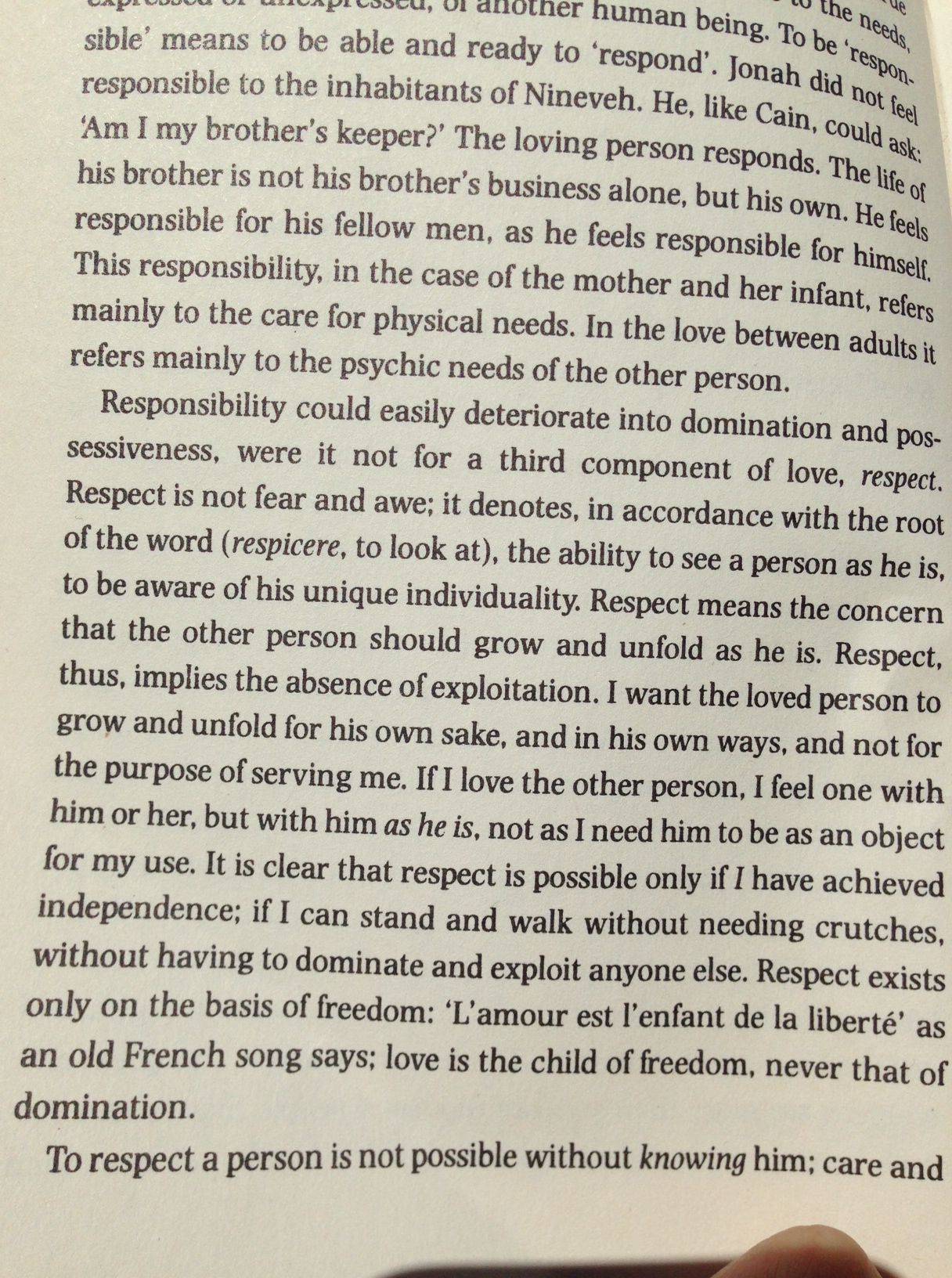 – The Art of Loving, Erich Fromm
Life is the continuous adjustment of internal relations to external relations. – Herbert Spencer
Houston Airport 8am
– mummy, when i grow up I’m going to fix this silly problem and let people bring water through security.
– thank you Luna.
>

“If we can manage not to push too hard when trying is bad, and not think too much when reflection is the enemy, the flow of life is always there, eager to pull us along in its wake.” – Edward Slingerland 




“The quieter you become, the more you can hear.” – Baba Ram Das
Now you children be quiet like good little ladies and gentlemen. Don’t you children know any quiet games–like staring at each other with your mouths shut?
– Mr Wilson (Dennis the Menace)
br />






Followed the sun back to London
only to get lost in the forests
of China and Japan,
enveloped in the scent of
tatami & hinoki.
https://www.royalacademy.org.uk/exhibition/4



A bit more from Shantaram:
A group of senior men – a former Afghan guerrilla, a stateless Palestinian, a Bombay gangster, and the main character are smoking hash and discussing the meaning of suffering. They each state their opinions in turn:
Khaled (the Palestinian): ‘I know that suffering is the truth. I know that suffering is the sharp end of the whip, and not suffering is the blunt end – the end that the master holds in his hand. If you’d been born in Palestine, you’d know that some people are born to suffer. And it never stops, for them. Not for a second. You’d know where real suffering comes from. It’s the same place where love and freedom and pride are born.’
Farid: ‘I think our brother Khaled is right, in a way. I think that happiness is a really thing, a truly thing, but it is what makes us crazy people. Happiness is a so strange and power thing that it makes us to be sick, like a germ sort of thing. And suffering is what cures us of it, the too much happiness. The – how do you say it? – burden.’ […] The burden of happiness can only be relieved by the balm of suffering.’ […] ‘Yes, yes, that is what I want to say. Without the suffering, the happiness would squash us down.’
Kader (the big boss and the one everyone has been waiting to hear speak on this topic): ‘I think that suffering is the way we test our love. Every act of suffering, no matter how small or agonisingly great, is a test of love in some way. Most of the time, suffering is also a test of our love for God.’ […]
He continues, ‘Now I will move on to my more detailed answer. The Holy Koran tells us that all things in the universe are related, one to another, and that even opposites are united in some way. I think that there are two points about suffering that we should remember, and they have to with pleasure and pain. The first is this: that pain and suffering are connected, but they are not the same thing. Pain can exist without suffering, and it is also possible to suffer without feeling pain. […] The difference between them is this, I think: that what we learn from pain – for example, that fire burns and is dangerous – is always individual, for ourselves alone, but what we learn from suffering is what unites us as one human people. If we do not suffer with our pain, then we have not learned about anything but ourselves. Pain without suffering is like victory without struggle. We do not learn from it what makes us stronger or better or closer to God.’
Abdul Ghani interjects: ‘And the other part, the pleasure part?’
‘Ah’, Kader continued, ‘I think that it’s a little bit like what Mr Lin tells us about [terrorist] Sapna’s use of words from the Bible. It is the reverse. Suffering is exactly like happiness, but backwards. One is the mirror image of the other, and has no real meaning or existence without the other.’
An excerpt from a conversation in Shantaram.
A group of foreigners and Indians are talking about hardships they’ve been through, and how much the slumdwellers suffer all the time. The main character’s love interest (unrequited) is about to speak:
We all turned our attention to Karla. She toyed with her cup for an instant, turning it slowly in the saucer with her long index finger. “I think that we all, each one of us, we all have to earn our future.” she said slowly. “I think the future is like anything else that’s important. It has to be earned. If we don’t earn it, we don’t have a future at all. And if we don’t earn it, if we don’t deserve it, we have to live in the present, more or less forever. Or worse, we have to live in the past. I think that’s probably what love is – a way of earning the future.”
Apparently today a Double Black Moon is meant to appear in the night sky. Note that there is no scientific evidence of this moon-event but I have become obsessed with all things mystical around the moon given that my daughter’s name is Luna. The double lunation occurs every two and a half to three years and is associated with higher consciousness, hidden wisdom, the deepening of communication with the angelic, fairy and spiritual realms.
Some believe the wishes you make on a double black moon come true. So I’ve been thinking long and hard about what I wish today. And what I wish–above all else–is to be the best mother possible to my gorgeous daughters. To love them, cherish them, to deepen my communication with them, to reach a higher consciousness with them and to live together with them in all things magical.
I dedicate this short film to Philomena and Luna. My greatest loves. I love you all the way to the moon–across the moon and back.
Moonwalk – http://aeon.co/film/moonwalk-a-short-film-about-the-ultimate-moon-shot/






For more on Wicca beliefs see here:
http://www.bbc.co.uk/religion/religions/paganism/beliefs/beliefs.shtml
Read about the extraordinary work that Nikki Cameron and the Low Moss Philosophy Club are doing to raise consciousness in prisons by teaching philosophy. Low Moss emphasise the Stoic idea that although we lack control over many aspects of our environment, we do have some choice over own thoughts, beliefs and actions. That although we may not control the past or the future, we can control the present. That although we cannot control what has already happened to us, we are still able to control how we respond to it.
Jules Evans (Philosophy for Life) writes about their work here:


When you arise in the morning, think of what a precious privilege it is to be alive—to breathe, to think, to enjoy, to love. – Marcus Aurellus






























<p></p>




 Girlwithoutawatch
