Happiness is when you find a little slice of paradise (go team saints)
27 03 2014Comments : Leave a Comment »
Categories : Uncategorized
Aaahh-we used to sing this to each other- my dad (on love)
27 03 2014
Comments : Leave a Comment »
Categories : Uncategorized

Happiness is being on route to the city that care forgot
26 03 2014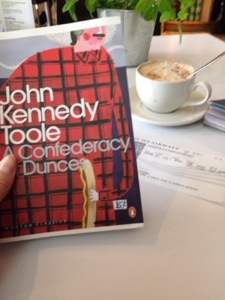
I suspect that beneath your offensively and vulgarly effeminate façade there may be a soul of sorts. Have you read widely in Boethius?”
“Who? Oh, heavens no. I never even read newspapers.”
“Then you must begin a reading program immediately so that you may understand the crises of our age,” Ignatius said solemnly. “Begin with the late Romans, including Boethius, of course. Then you should dip rather extensively into early Medieval. You may skip the Renaissance and the Enlightenment. That is mostly dangerous propaganda. Now that I think of it, you had better skip the Romantics and the Victorians, too. For the contemporary period, you should study some selected comic books.”
“You’re fantastic.”
“I recommend Batman especially, for he tends to transcend the abysmal society in which he’s found himself. His morality is rather rigid, also. I rather respect Batman.
Comments : Leave a Comment »
Categories : Uncategorized
LOVE is how the LIGHT gets in
26 03 2014all of these artists will all be performing here: http://howthelightgetsin.iai.tv/
Mr. Scruff also sells tea. Proceeds go to charity. Check it out. http://www.makeusabrew.com/showscreen.php?site_id=20&screentype=site&screenid=20
“Dulce et decorum est pro patria mori”
The poem from which the line comes exhorts Roman citizens to develop martial prowess such that the enemies of Rome will be too terrified to resist them. In John Conington‘s translation, the relevant passage reads:
To suffer hardness with good cheer,
In sternest school of warfare bred,
Our youth should learn; let steed and spear
Make him one day the Parthian’s dread;
Cold skies, keen perils, brace his life.
Methinks I see from rampired town
Some battling tyrant’s matron wife,
Some maiden, look in terror down,—
“Ah, my dear lord, untrain’d in war!
O tempt not the infuriate mood
Of that fell lion I see! from far
He plunges through a tide of blood!”
What joy, for fatherland to die!
Death’s darts e’en flying feet o’ertake,
Nor spare a recreant chivalry,
A back that cowers, or loins that quake.
(thank you wikipedia for always being there for me when i need you)
Afro-Beat Collective, explores the need and importance of exploring for the sake of exploring…”The objective is to to create music derived from a deliberate intention to transmit a message of determination, substance and, most importantly, Unity. To see music as One World, a musical space that transcends and breaks free from styles and any kind of sound that compromises the skills of the musicians playing and the importance of musicianship or group collaboration and expression.” – HENRY COLE & AFROBEAT COLLECTIVE
Comments : Leave a Comment »
Categories : Beauty, Creativity, Imagination, Language, Love, Purpose, Uncategorized
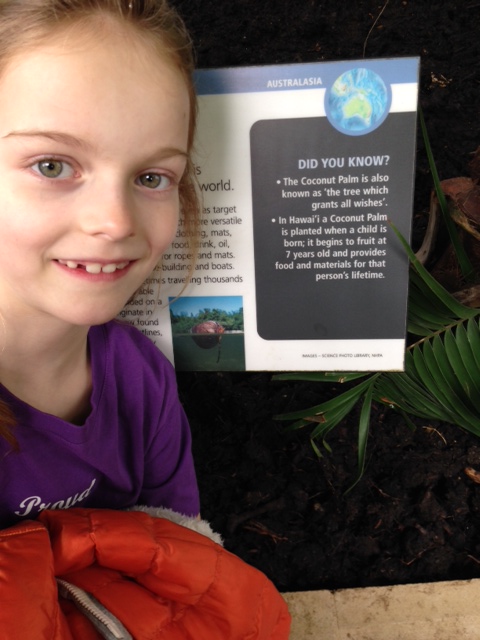
What Philomena discovered at Kew Gardens
25 03 2014

Comments : Leave a Comment »
Categories : Uncategorized
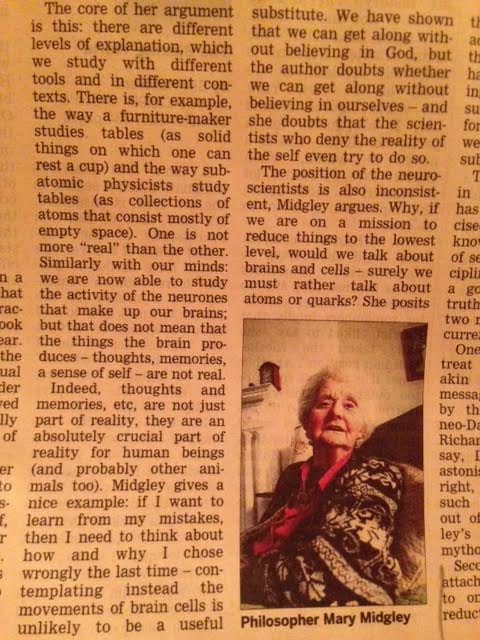
In LOVE with Mary Midgley
24 03 2014“The trouble with human beings is not really that they love themselves too much; they ought to love themselves more. The trouble is simply that they don’t love others enough” – Mary Midgley (one of our wisest living philosophers)
Mary is a mother of three and so much of what she writes about resonates with me–particularly her confidence in humanity, the emphasis she places on the importance of seeing the world from multiple (non-judgemental) perspectives and her concern that overspecialisation is a handicap to our human capacity for thought.
But one my favourite of all the things she said is: “I wrote no books until I was a good 50, and I’m jolly glad because I didn’t know what I thought before then.”
At 94-years of age, Mary just published her 15th book, Are you an Illusion? (FT review here:http://www.ft.com/cms/s/2/70476606-ae8e-11e3-aaa6-00144feab7de.html#axzz2woyHZyZV
Comments : Leave a Comment »
Categories : Uncategorized
Gift’s from HAFIZ
23 03 2014Hafiz is the most beloved poet of Persia. He lived around the same time as Chaucer and hundred or so years after Rumi. He became known in the West through the efforts of Goethe and Ralph Waldo Emerson, who translated Hafiz in the 19th Century.
A beautiful morning read.
WHEN THE VIOLIN When The violin Can forgive the past It starts singing. When the violin can stop worrying About the future You will become Such a drunk laughing nuisance That God Will then lean down And start combing you into His Hair. When the violin can forgive Every wound caused by Others The heart starts Singing. A STRANGE FEATHER All The craziness, All the empty plots, All the ghosts and fears, All the grudges and sorrows have Now Passed. I must have inhaled A Strange Feather That finally Fell Out. I AM REALLY JUST A TAMBOURINE Good Poetry Makes the universe admit a Secret: “I am Really just a tambourine, Grab hold, Play me Against your warm Thigh.”Comments : 2 Comments »
Categories : God, Happiness (Wit = α+βxit+εit), Love, Poetry, Uncategorized
Atomic Bomb
22 03 2014Comments : Leave a Comment »
Categories : Uncategorized
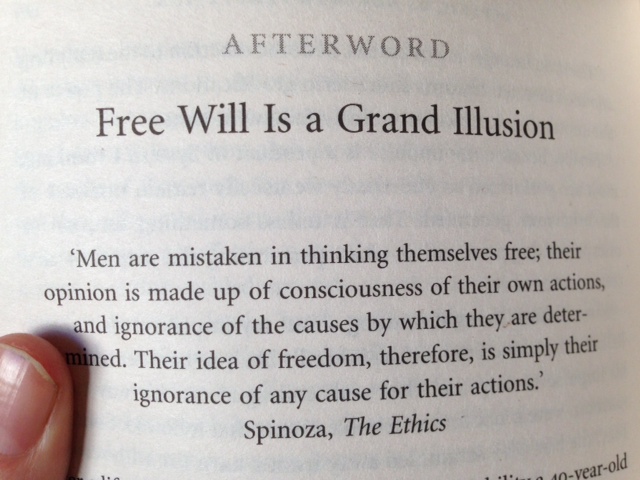
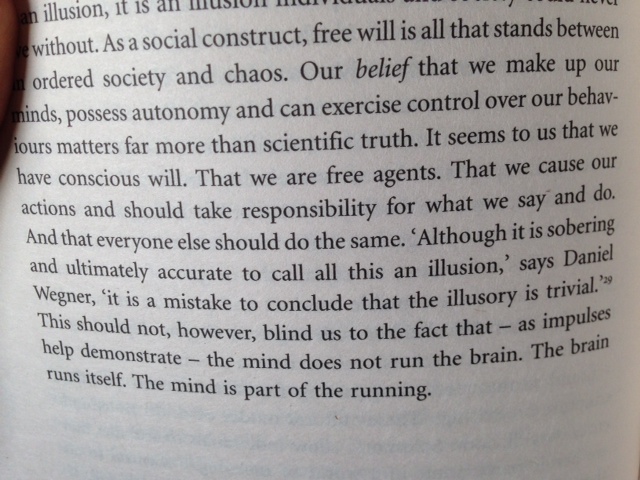
Books For Breakfast w Richard Kilgarriff & Dr David Lewis
21 03 2014

Comments : Leave a Comment »
Categories : Free Will, Uncategorized
An excavation
21 03 2014
Comments : Leave a Comment »
Categories : Free Will, God, Happiness (Wit = α+βxit+εit)
Push the Bush
21 03 2014
Comments : Leave a Comment »
Categories : Economics, God, Imagination, Love, Morality, Purpose, Uncategorized
divine music
21 03 2014
22 Do not merely listen to the word, and so deceive yourselves. Do what it says. 23 Anyone who listens to the word but does not do what it says is like someone who looks at his face in a mirror 24 and, after looking at himself, goes away and immediately forgets what he looks like. 25 But whoever looks intently into the perfect law that gives freedom, and continues in it—not forgetting what they have heard, but doing it—they will be blessed in what they do.
Comments : Leave a Comment »
Categories : God, Poetry, Uncategorized
Sacrificing Strawberries
4 03 2014Luna – Mummy what will you give up for LENT?!
Mummy – That’s a good question, I don’t think I’ve given up anything for lent in a VERY long time.
Philomena – How long exactly?
Mummy – I think the last time was when I was 12 or 13.
Luna – I’m giving up strawberries. I LOVE strawberries, so I’m giving up strawberries.
Philomena – So what will YOU give up, Mummy?
Mummy – I’m not sure, what do you think I should give up?
Philomena – It has to be something you really love.
Mummy – Hmmmmm.
Luna – Like STRAWBERRIES.
Philomena – Or PANCAKES– I’m giving up pancakes.
Mummy: Hmmmmmm.
Luna – You could give up COFFEE? You always drink lots and lots of coffee.
Philomena – Or WINE? That would be a good one.
Mummy – Do I have to give up something I like to eat or drink — or could it be something else? There are lots of things I love.
Philomena – Oh, I KNOW! You love writing. Why don’t you give up WRITING for 40 days?!?!
Mummy – Wow. Let me sleep on that idea. Do we have to tell each other what we give up? Is that part of it?
Comments : 1 Comment »
Categories : Free Will, God, Love, Uncategorized
Through Love’s Great Power-A Mother and a Judge Speaks Out on Section 377
26 02 2014Through Love’s Great Power
By Vikram Seth
Through love’s great power to be made whole
In mind and body, heart and soul—
Through freedom to find joy, or be
By dint of joy itself set free
In love and in companionhood:
This is the true and natural good.
To undo justice, and to seek
To quash the rights that guard the weak—
To sneer at love, and wrench apart
The bonds of body, mind and heart
With specious reason and no rhyme:
This is the true unnatural crime.
See article copied below from The Times of India written by Vikram Seth’s mother, Leila Seth, age 83.
“A Mother and a Judge Speaks Out on Section 377.”
My name is Leila Seth. I am eighty-three years old. I have been in a long and happy marriage of more than sixty years with my husband Premo, and am the mother of three children. The eldest, Vikram, is a writer. The second, Shantum, is a Buddhist teacher. The third, Aradhana, is an artist and filmmaker. I love them all. My husband and I have brought them up with the values we were brought up with—honesty, courage, and sympathy for others. We know that they are hardworking and affectionate people who are trying to do some good in the world.
But our eldest, Vikram, is now a criminal, an unapprehended felon. This is because, like many millions of other Indians, he is gay; and last month, two judges of the Supreme Court overturned the judgment of two judges of the Delhi High Court that, four years ago, decriminalized homosexuality. Now, once again, if Vikram falls in love with another man, he will be committing a crime punishable by imprisonment for life if he expresses his love physically. The Supreme Court judgment means that he would have to be celibate for the rest of his life or else leave the country where he was born, to which he belongs, and which he loves more than any other.
I myself have been a judge for more than fourteen years—first as a judge on the Delhi High Court, then as Chief Justice of the Himachal Pradesh High Court. Later, I served as a member of the Law Commission, as well as the Justice J.S. Verma Committee, which resulted in the Criminal Law Amendment Act 2013 being passed. I have great respect for legal proprieties in general, and would not normally comment on a judgment, but I am making an exception in this case.
I read the judgment of the Delhi High Court when it came out four years ago. It was a model of learning, humanity, and application of Indian constitutional principles. It was well crafted, and its reasoning clearly set out. It decided that Section 377 of the Indian Penal Code infringed Article 14 of the Constitution, which deals with the fundamental right to equality. It infringed Article 15, which deals with the fundamental right to nondiscrimination. And it infringed Article 21, which covers the fundamental right to life and liberty, including privacy and dignity. The judgment of the High Court “read down” Section 377 in order to decriminalize private, adult, consensual sexual acts.
The government found no fault with the judgment and did not appeal. However, a number of people who had no real standing in the matter did challenge it. Two judges of the Supreme Court heard the appeal in early 2012. Then, twenty-one months later, and on the very morning of the retirement of one of them, the judgment was finally pronounced. The Delhi High Court judgment was set aside, Section 377 was reinstated in full, and even private, adult, consensual sexual acts other than the one considered “natural” were criminalized again.
As the mother of my elder son, I was extremely upset. But as a lawyer and a former judge, I decided to reserve my views till I had read the judgment. When I read it, it would be true to say that I found it difficult to follow its logic.
A host of academics and lawyers have critiqued the judgment in great detail, including the nonaddressal of the Article 15 argument, and have found it wanting in many respects. I do not intend to repeat those criticisms. However, I should point out that both learning and science get rather short shrift. Instead of welcoming cogent arguments from jurisprudence outside India, which is accepted practice in cases of fundamental rights, the judgment specifically dismisses them as being irrelevant.
Further, rather than following medical, biological, and psychological evidence, which shows that homosexuality is a completely natural condition, part of a range not only of human sexuality but of the sexuality of almost every animal species we know, the judgment continues to talk in terms of “unnatural” acts, even as it says that it would be difficult to list them.
But what has pained me and is more harmful is the spirit of the judgment. The interpretation of law is untempered by any sympathy for the suffering of others.
The voluminous accounts of rape, torture, extortion, and harassment suffered by gay and transgender people as a result of this law do not appear to have moved the court. Nor does the court appear concerned about the parents of such people, who stated before the court that the law induced in their children deep fear, profound self-doubt, and the inability to peacefully enjoy family life. I know this to be true from personal experience. The judgment fails to appreciate the stigma that is attached to persons and families because of this criminalization.
The judgment claimed that the fact that a minuscule fraction of the country’s population was gay or transgender could not be considered a sound basis for reading down Section 377. In fact, the numbers are not small. If only 5 percent of India’s more than a billion people are gay, which is probably an underestimate, it would be more than 50 million people, a population as large as that of Rajasthan or Karnataka or France or England. But even if only a very few people were in fact threatened, the Supreme Court could not abdicate its responsibilities to protect their fundamental rights, or shuffle them off to Parliament. It would be like saying that the Parsi community could be legitimately imprisoned or deported at Parliament’s will because they number only a few tens of thousands. The reasoning in the judgment that justice based on fundamental rights can only be granted if a large number of people are affected is constitutionally immoral and inhumane.
The judgment has treated people with a different sexual orientation as if they are people of a lesser value.
What makes life meaningful is love. The right that makes us human is the right to love. To criminalize the expression of that right is profoundly cruel and inhumane. To acquiesce in such criminalization or, worse, to recriminalize it is to display the very opposite of compassion. To show exaggerated deference to a majoritarian Parliament when the matter is one of fundamental rights is to display judicial pusillanimity, for there is no doubt that in the constitutional scheme it is the judiciary that is the ultimate interpreter.
A review petition is now up for hearing before one of the two original judges plus another, who will replace the now retired Justice Singhvi. It will be heard in chambers. No lawyers will be present.
I began by saying that Premo and I had brought up our children to believe in certain values. I did not mention some others that we have also sought to inculcate in them: to open their hearts and minds; to admit their errors frankly, however hard this may be; to abjure cruelty; and to repair in a willing spirit any unjust damage they have done to others.
Comments : Leave a Comment »
Categories : Love, Poetry, Purpose, Uncategorized
Happiness is remembering your family. Santa Cruz, Bolivia 1974
11 02 2014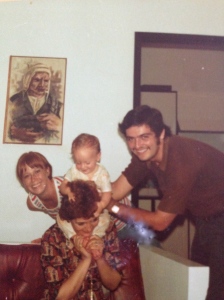
my mom, my dad and me on top of my grandmother’s shoulders.


familia Barbery. with my grandfather, Bobo (on the right, in a yellow shirt holding sunglasses)

Comments : Leave a Comment »
Categories : Happiness (Wit = α+βxit+εit)
Wise children: “The ant doesn’t know that there’s more than the patio here. He just keeps walking…”
3 02 2014I ask you, my friends, not to condemn me entirely to the mill of mathematical calculations, and to allow me time for philosophical speculations, my only pleasures. – Johanes Kepler (1619)
Comments : 1 Comment »
Categories : Uncategorized
Children are like fresh globules of tantalizing rain
31 01 2014Children are like fresh globules of tantalizing rain; which spell bindingly descend in euphoric frenzy from fathomless carpets of glorious sky, Children are like innocuous tufts of cotton soaring ebulliently in handsome atmosphere; philandering in stupendous melody under carpets of gloriously blissful sunshine, Children are like the pristine rays of Omnipotent Sun; profoundly illuminating one and all; with their vibrantly intriguing imagery; alike, Children are like the fairies of irrefutable truth dancing in the celestial heavens; with their immaculately divine consciences boundless kilometers away; from the despicable gutter of lies, Children are like ecstatically redolent roses brazenly swaying in the afternoon winds; unfurling into majestic artistry and overwhelmingly tangy boisterousness; as each second speedily zipped by, Children are like fulminating springs of rhapsodically untamed jubilation which erupt from the inner most core of earth; incessantly blooming into a paradise of new found energy; an insatiable euphoria to propel forward in life, Children are like united colors of the vivaciously radiant rainbow; embracing each other in compassionate cradles of humanity; entirely oblivious to the satanic vagaries of caste; creed; religion and spurious color, Children are like the resplendently milky beams of the innocent Moon; perennially twinkling in the unparalleled exuberance of discovery; indefatigably exploring all bountiful happiness so fantastically laden upon this colossal planet, Children are like voluptuously nimble blades of dew drop coated grass; profusely ringing in the whole some merriment of symbiotic existence; whistling past the meadows of inexplicably ghastly sorrow; with Omnipotent beauty in their tiny souls, Children are like scintillatingly majestic eagles soaring royally through the silken clouds; uninhibitedly kissing all goodness that confronted them in their way; on every step that they poignantly tread, Children are like angels of relentlessly philanthropic benevolence; donating even the most priceless of their possession; to their comrades in agonizing pain, Children are like the sparkle of seductively ethereal dawn; deluging every disastrously bereaved household; with the ingratiatingly timeless essence of joyously beautiful existence, Children are like steps leading to the sacrosanct Creator; unassailably fortifying your persona to face the deadliest of evil; as you clambered each foot forward, Children are like rambunctiously revered and bushy squirrels up in the foliated trees; eternally unfolding into insurmountable enthusiasm; leaping fleet- footedly to metamorphose beleaguered earth once again into an Omniscient paradise, Children are like unfathomable treasure hoves of captivating honey; oozing the ultimate sweetness of godly creation; with the incredulous ardor in their heavenly voice, Children are like charms of everlasting luck; magically transforming your despairingly deplorable survival; into a life replete with profusely endearing graciousness, Children are like invincibly boundless mountains of faith; instilling Herculean courage in all those miserably dwindling; by just the unprecedented fervor of brilliant optimism; lingering enchantingly in the whites of their eyes, Children are like petals of Omnipresent prosperity; ubiquitously diffusing the spirit of happiness and immortal humanity; to every penuriously ailing entity on the trajectory of this endlessly glittering planet, And Children are like the supremely divine aura of Godhead; granting every benign desire in your heart to be perpetually true; the instant you held their beaming palms to frolic with them in the gardens of; unconquerable togetherness….
– Nikhil Parekh, Ahmedabad, India
Comments : Leave a Comment »
Categories : Uncategorized
“they’re kissing so wildly” – Luna
27 01 2014(Conversation between Philomena and Katarina, both age 6)
– You know I kissed Theo when I was 5. – Yuck. – It’s not yuck, one day we will get married. – Married people don’t kiss! – Yes they do! – No they don’t–when you are boy friend and girl friend you kiss, not when you’re married.After over-hearing this conversation I began making it a point to smother my husband with kisses on the lips in front of the children. I was on a mission to prove Katarina wrong. Married people do kiss, dammit. Not only do they kiss but they also have great sex—lots of sex. In fact, once you have children, sex just gets better and better—the bonds become stronger, given all the stimulating and complex challenges parents face together, and emotional connections become exponentially more intense. Love, passion and family-life go hand in hand.
I wish this were always true. But the reality is I too rarely catch a glimpse of married people kissing on the lips. Maybe that’s because I live in London. Perhaps if I lived in Buenos Aires, I’d see married people making out on every park bench. All I know is that most of my friends with children—and these are pretty multi-cultural friends who are spread across a number of continents tell me a similar story: they rarely have the time or energy for proper kissing.
A survey carried out by the British Heart Association revealed that 20% of married couples can go a week without kissing—did that mean that 80% of couples kiss everyday? If that were true I would let 6-year-old-Katarina know immediately. I do wish someone would carry out that study because I desperately want to know more about kissing—not the quick, 1950s-style-honey-I’m-home kind of peck, and not the slightly embarrassing tongue-swishing kind either—I want to know about those sweet, in-between kisses, the ones that last 3-5 seconds, the ones that force you to slow down just a bit, just enough to pause and re-connect.
One day I tried to keep track of how many times I kissed my children relative to my husband—it was a very silly exercise. I lost track very quickly as my girls receive kisses every few minutes–not only on their lips, but their cheeks, forehead, top of head, hands, belly and feet– they are constantly smothered in affection. In contrast, I calculated an average of two pecks and one kiss a day with my husband—the have-a-great-day-departure-peck in the morning and the honey-I’m-home-peck in the early evening. The honey-I’m-home-peck occurs after rolling around on the floor with the children in a frenzy of giggling and kisses, which is of course a beautiful site to see, but the contrast between their intimacy, their lightness in being, their capacity to make space to connect and our own capacity to do so becomes instantly apparent. I hate pecks—I tell my husband all the time, if you’re going to peck me, peck me on the cheek, not the lips—my lips are reserved only for kissing. It’s not always easy to remember these things.
It is extraordinary how much our children value kissing–not the kisses they receive but the kissing they observe.
Video Luna’s take on kissing: https://vimeo.com/85147626
<p>27.1.2014</p>Comments : 1 Comment »
Categories : Uncategorized
 Girlwithoutawatch