a little princess–movie night with the girls

25 01 2014

A very long time ago…
… there lived a beautiful princess,
in a mystical land known as…
…lndia.
She was married to the
handsome Prince Rama…
… who had been banished
to the enchanted forest…
…by his jealous stepmother,
Queen Kaikeyi.
One day…
…Princess Sita saw a wounded deer
in the woods…
…and she begged Rama
to go and help it.
Rama drew a circle in the ground
and said to her:
”This is a magic circle.
So long as you stay inside it…
…no harm can come to you. ”
That night,
the princess heard a horrible cry.
Help me.
Thinking it was her beloved Rama
in danger…
… the princess ran from the circle
to answer the cry.
She soon came across
an old beggar man.
Although she had no money
to give him…
…she could not refuse his plea.
As soon as he had the bracelet…
. . .he transformed into the
He grabs her and takes her
to his palace. . .
. . .to make her his bride.
Did you ever know
a real prince, Maya?

– A Little Princess (1995) Movie Script

conversation with Philomena during the film (age 7)

– mummy, why did they just call her a princess? is she a real princess?
– because being a princess is about behaving like a princess. and she just did didn’t she?
– like thinking of others first, before yourself, right?
– yes, my love, exactly.

l am a princess.
All girls are.
Even if they live
in tiny old attics.
Even if they dress in rags.
Even if they aren’t pretty
or smart or young.
They’re still princesses.
All of us.

– A Little Princess (1995) Movie Script

had no idea alfonzo cuaron made this gorgeous film. so wonderful.


On Love Spells and Longing

23 01 2014
Glorious Sachiel,
Angel of love,
Open your wings and guide from above,
Guide to me my soul’s twin flame,
Together, as one, we live again. 

It is worth saying something about the difference between desire and longing. Wanting is clear, purposive, urgent, driven by the will, always with its goal clearly in view. Longing, by contrast, is something that ‘happens’ between us and another thing. It is not directed by will, and is not an aim, with the ultimate goal of acquisition; but instead is a desire for union–or rather it is experienced as a desire for re-union.   – Iain Mcgilchrist

Conversation with Eleanor, age 6.
–       Who are you?
–       I am a witch. These are my potions.
–       Oh, I see. And what will you do with these potions?
–       They are love potions—to make people fall in love. Some of the girls are already in love but not all of them so I’m going to cast a spell on them.
–       And what will happen to them once they receive your love spell? What will they feel?
–       They will be in love, silly.
–       I see. And how long will your spell last–will they be in love forever?
–       Mmmmmm. That, I’m not sure really.


Conversations with Philomena age 3,4,5,6, and 7.
Philomena age 3.
–       Mummy, when I grow up, I’m going to marry Maxim.
Philomena age 4
–       Mummy, when I grow up, I’m going to marry Maxim.
Philomena age 5
–       Mummy, when I grow up, I’m going to marry Maxim.
Philomena age 6
–       Mummy, when I grow up I might marry Maxim but I might also marry Theo.
Philomena age 7
– Mummy, do you know why I can’t decide if I am going to marry Theo or Maxim? It’s because Theo lives here in London—he’s close by and Maxim lives really far away. Do you think I’ll never see Maxim again, Mummy? Because Australia is so far away, isn’t it? Will we ever visit Australia?


Who has not, gazing up at the starry night, held out hope that their “other half” is out there somewhere, gazing up at the same heavens and dreaming of them? That one day they should be brought together by a divine plan, a destiny to become one again, to become whole. Be careful what you wish for. Love spells cause a great number of side effects: Tightness in chest, racing heart, obsessive thoughts, aching mind, awestruck worship and a terrible sense of longing that leads to something disembodied, something beyond conscious experience. A kundalini rising.

Most of us have experienced it at one point or another in life—that bewitching moment when we engage in conversation with someone for the first time and feel a sensation of connectedness so profound that the stranger standing before us can no longer be considered a stranger. That bewitching moment when we look deep within the eyes of another and realise that we have (as Mcgilchrist mentioned above) been reunited with our other half, with the soul mate we hadn’t even realised we were searching for. That bewitching moment when any semblance of reason gives way to an almost painful longing to be close, because we feel understood, deeply understood, for the first time. That bewitching and seductive moment when we are at first stirred and then bound by an electrical current, some higher spiritual energy, a force that leaves us no other choice than to love at once, unconditionally.

Plato portrayed this twin-soul image twenty-five centuries ago, in a legend filled with androgynous creatures. In Plato’s Symposium, Aristophanes speaks in praise of love, relating how Zeus struck the soul into two opposite halves, each to wander the earth in search of the other. The belief is that each one of us, on a deeply subconscious level, knows that something is missing within ourselves, and we seek wholeness.

And when one of them meets with his other half, the actual half of himself, the pair are lost in amazement of love and friendship and intimacy and one will no be out of the others’ sight even for a moment. These are the people who pass their lives together; yet they could not explain what they desire of one another. For the intense yearning which each of them has towards the other does not appear to be the desire of lovers’ intercourse, but of something else which the soul of either evidently desires and cannot tell, and of which she has only a dark and doubtful presentiment.   

 If Hephaestus, son of Zeus, were to ask the pair: Do you desire to be wholly one, always day and night to be in one another’s company? For if this is what you desire, I am ready to melt you into one and let you grow together, so that being two you shall become one, and after your death in the world beyond you will still be one departed soul instead of two—I ask whether this is what you lovlingly desire? – and there is not a man or woman of them who, when they heard the proposal, would not acknowledge that this melting into one another, this becoming one instead of two, was the very expression of their ancient need. And the reason is that human nature was originally one and we were a whole, and the desire and pursuit of the whole is called love.


My daughter Philomena is very romantic. She let’s everyone know, “my name means love.” There is no question in her mind that one-day, she will meet her soul mate and they will marry. In fact, she is pretty convinced that she has already met him. At age 3.

Is that possible? Is it possible to meet your soul mate so young? That Philomena’s soul is somehow connected to this little boy Maxim’s who she’s been obsessed with for so long? We’re going on 4 years now since their first encounter and she continues to talk about him with such certainty.  I do hear about this kind of thing all the time from the many mothers I meet. They tell me of their toddlers falling madly in love and holding on to that love despite time passing (over many years, irrespective of whether the children have moved on to different schools, different countries). It seems so extraordinary to me.

My youngest daughter, Luna, also seems to have found a soul mate. Not in a boy she wants to marry but in her best girlfriend, Haruka. They too met at age 3 and have since moved on to different schools, but every week Luna produces a piece of art-work to send to her friend. Every week she asks when she will see Haruka next. I feel the longing in her voice. She often cries and tells me how much she misses her.

Plato’s mythical tale does not present an argument that we are destined to be with our soul mates in marriage or romance. It is a tale about the search for our other half—the part of our self that is missing. Maybe the uncontrollable longing to melt into one with someone we meet for the first time—when we feel that bolt of lightening—is more about self-realisation than anything else. A mirror of love reflected back upon us. A shared reflection of love.

Perhaps too often we grown ups misinterpret what it means when we finally meet our soul mate—or when we appear to be meeting our soul mate again and again, as the case may be. In this age, where people are finding it hard to connect and forge lasting relationships, the idea of the soul mate, of a cosmic quest, may actually prevent people from being happy with the person they are with and from finding joy in the little things — the normal, nonmystical, yet beautiful things that couples must do to make a relationship work.

Does the belief in and search for a soul mate create unrealistic expectations of what true love is all about? What do our children help reveal about the unexplained sense of longing and connection we feel towards others? Should we melt into one with our soul mate or are our souls meant to be split? Perhaps they are only meant to come together from time to time to reassure us that we are part of a whole?


Listening at the fringe

12 01 2014

Every time I come to the Southbank I wonder why it is that I do not spend every day here. I didn’t manage to get tickets to the T.S. Elliot Prize readings tonight as I thought I might—but drinking wine at Skylon, looking over at the river below, the blue lights, the train racing south to north and north to south. I feel privileged just to listen at the door.  

Below is a taster of what I might have heard but read to myself instead beside the river.

Talking to myself

In the mildew of age

All pavements slope uphill

Slow slow

Towards an exit.

It’s late and light allows

the darkest shadow to be born of it.

Courage, the ventriloquist bird cries

(a little god, he is, censor of language)

remember plain Hardy and dandy Yeats

in their inspired wise pre-dotage.


I, old man, in my new timidity,

think how, profligate, I wasted time

–those yawning postponements on rainy days,

those paperhat hours of benign frivolity.

Now Time wastes me and there’s hardly time

to fuss for more vascular speech.

The aspen tree trembles as I do

And there are feathers in the wind.

Quick quick

Speak, old parrot,

Do I not feed you with my life?

–       Dannie Abse

Wife of Brain

don’t say you weren’t

expecting a volcano those

red wings

that not even bad love can

tame

must signify something’s

somewhere

about to go up in flame or

(as Proust says) be

eternalized in pleasure

like the men

in a Pompeian house of ill

fame yet fame

is not ill

for all

in this tale Sad may be a

goner

but Io’s getting ready

for her free

throw

with one eye on the herd

and the other on that

pyroclastic glow

– Anne Carson

We Love Life, Whenever We Can

We love life whenever we can,

We enter the grocer’s, the baker’s, the chemist’s

    the post office daily.

We love life whenever we can.

We borrow each other’s books and paperclips

   and forget to return them.

We spruce ourselves up for a meeting, order

   a taxi, climb into a bus or a train.

We love life whenever we can

   and so we sign letters and cards and spend

   the evening walking the street

 when the winter is fiercest and the light

   in the windows and amusement arcades

   snarls at the darkness and the sea is quietly chomping at

   the cliff and the owl and the rat and the fox move over and

   through and we hear them and listen.

We love life whenever we can.

– George Szirtes 


too bad you and papi can’t decide to have another baby

17 08 2013


Luna:  mummy too bad you and papi can’t decide to have another baby
Mummy:  what do you mean ‘we can’t decide’?
Luna:  because God decides not you
Mummy:  oh I see
Luna:  yea too bad. because now I decided that I actually want a little sister instead of a little brother
Mummy:  really — how come?
Luna:  I want to be able to play with a little sister without my big sister always being the boss
Mummy:  wouldn’t you still be the boss whether it was a boy or a girl?
Luna:  yea, I would be the boss but I’m not sure my brother would want to play the same games I want to play
Mummy:  well maybe you would learn some new games to play with him… I think he would enjoy lots of your games too
Luna:  yea. okay. anyway, it’s really okay. it doesn’t matter.  we just have to wait for God to decide and there is NOTHING we can do  about it! aaaggghhh. (she says shaking her head — hands waving in the air)


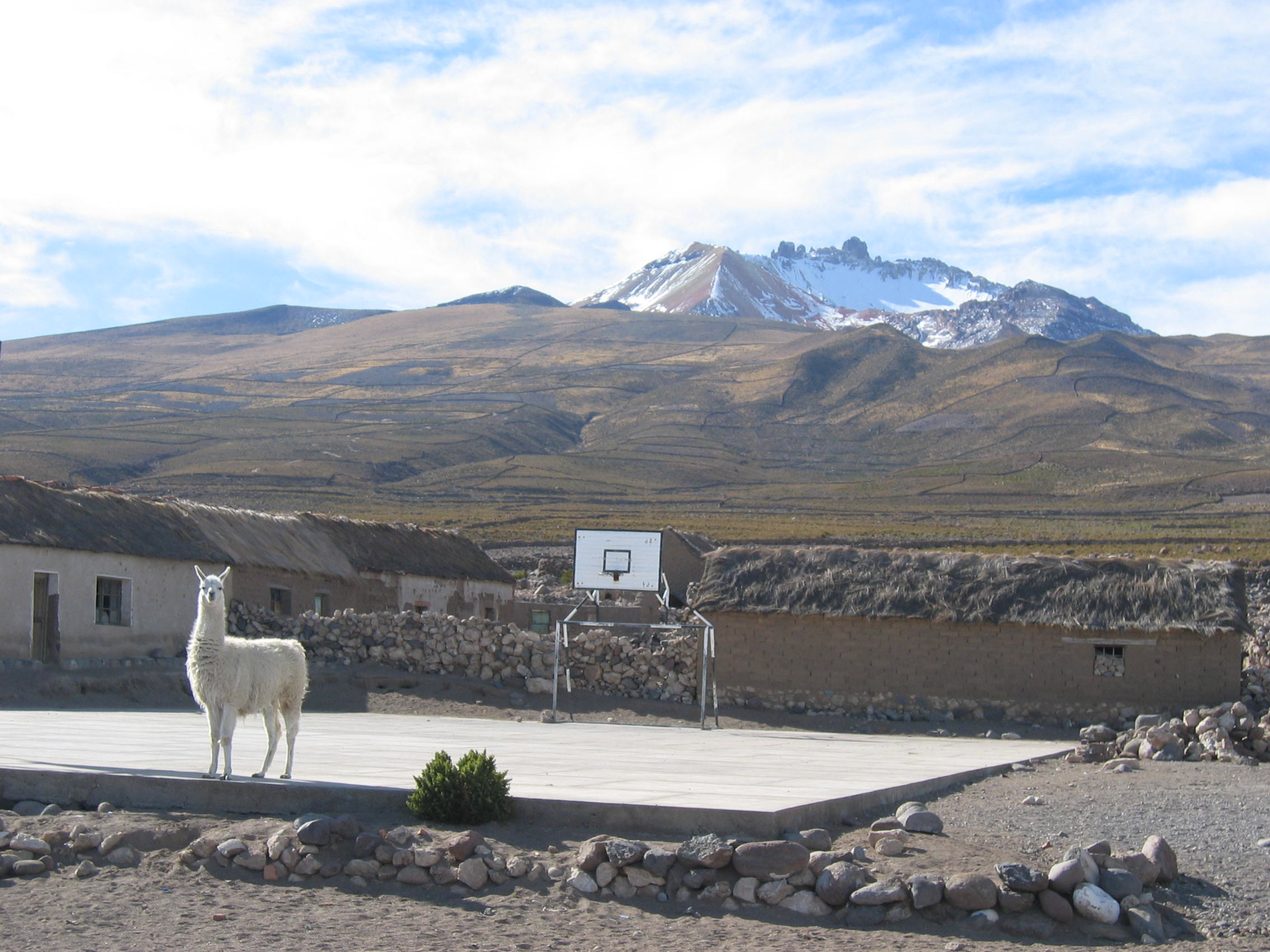
Illimani calling

10 08 2013
 
counting the days until i can get back to this extraordinary place
walk amongst the clouds together with my daughters
so close to heaven


“Then the nations that are left round about you shall know that I the LORD rebuild the ruined places, and replant that which was desolate: I the LORD have spoken it, and I will do it.” – Ezekiel 36:36

I read about this photo series by Nick Ballon in this weekend’s FT (http://www.ft.com/cms/s/2/1d61f46e-ffbc-11e2-b990-00144feab7de.html#slide0). Made me even more desperate to get back to Bolivia–this time together with my daughters.

This photo series documents Lloyd Aéreo Boliviano (LAB), one of the world’s oldest surviving airlines, which was founded in 1925 — it’s played a very special role in every stage of the country’s history. . www.labproject.co.uk


Sweetness should be gender-neutral

8 08 2013

Just read this article and in response to the Guardian’s request for comments, this is mine:

I want my daughters to be nice–VERY nice.

Although I was somewhat cognisant as a child about the power that comes from smiling (particularly in getting what I wanted from my parents), it wasn’t until I was 13 years old that I became fully aware of the power my smile could have on the outside world.

It was toward the end of the academic school year and I was using my smile, as well as my verbal skills, to convince my history teacher to accept an assignment that was 3 days overdue. I cannot remember what excuse I had up my sleeve on this particular occasion (as turning in assignments on time is something I have always struggled to do and I have more excuses than any other person I know) but whatever I did, worked. My teacher not only agreed to accept my late assignment but he also agreed not to take any points off for tardiness, so long as it remained “our little secret” (which it did until this very moment). Just as I was leaving the classroom, however, he stopped me, put his hand on my shoulder and looked sternly into my eyes. “You know, you aren’t always going to be able to use your smile to get away with things.” I couldn’t help but smile right back at him. He shook his head, rolled his eyes and walked back to his desk, smiling.

26 years after that conversation with my history teacher and I’m still smiling. I smile multiple times a day. Even when I am sad, stressed or angry, even when I am being serious, when I’m at a job interview, when I’m at a board meeting or giving a lecture, even when I’ve been called into my daughter’s school because she’s had a bad fall, even when a friend is crying in my arms of a broken heart—a smile will eventually creep up on me. This smile will provide perspective, a sense of calm and a sweetness, it will warm the moment; it will also infect whoever is in front of me.I was cute back then and I was sweet. I was a child after all—aren’t all children, irrespective of gender cute and sweet? And I had a killer smile. It worked like a charm and I got most things I wanted. But I was also smart, driven and curious about just about everything life had to offer. How in the world did we get to get to the point where we are questioning whether we want cute and sweet children who smile a lot?

Do I get a way with a lot of things other people don’t because of my smile?  Maybe. Do people with killer smiles generally get away with more in life? Who knows. Probably. All I know is that deep wrinkles are already setting in around the corners of my eyes but I’d choose these lines over frown lines any day.

Smiling is what makes us human. It softens us. It makes us even the toughest grown-up look sweet.

What an extraordinary trait: to be able to convey a message filled with positive energy without having to utter a single sound.

And the best part is that the moment you smile at someone they smile back. At least most of the time. We have all experienced the effect of a smile at some point in our lives and fortunately, we also have loads of scientific research for sceptics out there, demonstrating the effect that even a “fake” smile can have in provoking a sensation of happiness.

I think it is wrong to suggest that a smile is a female crutch. It is a human crutch and thank God we are all capable of smiling.

And yes, maybe some of us smile more than others but this is our gift not a curse.

I find it very strange that some people out there have come to peace with the idea of raising a child who doesn’t smile, but whatever, that is their own private matter. But it is abhorrent to use a girl with a frown wedged between her brows as a poster child for the feminist movement. It is also just plain ridiculous.

I want nothing more than my two daughters to feel empowered by their killer smiles and I want nothing more than for them to go through their entire life smiling—not as “if she is waitressing or pole-dancing or apologising for some vague but enormous infraction, like the very fact of her own existence” as Catherine Newman is so worried might be happening behind the smiling eyes of a child—but simply smiling.

And I want nothing more than for my daughters to use their killer smiles to infect people—as many people as possible in their lifetime—with happiness. Because that’s what it’s all about. They can have a rich intellectual and professional lives but without a capacity to muster up a carefree smile, without the capacity for kindness and generosity, a will to want to please others and to be accommodating, intellectual endeavours will always fall short of providing them with the happiness they deserve. Unlike Mrs Newman, I do want my daughters to wear their good nature like a gemstone—would much prefer that over any other material gems they may choose to adorn themselves with in the future.

I am certain that if I had sons I would want exactly the same for them.

Sweetness should be gender neutral.

IMG_2296


we are love

7 08 2013
we are love
we are made of love
we come from love and we go towards love
we die and we become eternal love
we are born and we awaken love
there is no such thing as love lost
only love misplaced and found again
love takes many forms and evolves:
it is a journey from conditional to unconditional
from selfish to selfless
from oneness to separateness and back to oneness
from eros to philia to agape


tooth-fairy is missing in action

5 06 2013

Something has happened to the tooth fairy. Perhaps you can help.

She was meant to come last night, after the dramatic departure of Tooth No.4, but she never showed up.

We think she may have lost her way.

Either that, or maybe her wing got caught in a thorn bush somewhere?

She might have crashed into our window and fainted–although given how dirty our windows are, Philomena thinks this is highly unlikely.

Depending on where the tooth-fairy was coming from, she might have been delayed by a snow storm (while snow-fairies have wings that work despite freezing temperatures, tooth-fairies do not).

It all really depends on where she was coming from. It might have simply been too long a journey for her and she will make it by tonight.

The fairy who came to collect Philomena’s Tooth No. 3 (a few days ago) flew all the way from Guatemala leaving 50 Quetzales under her pillow. A few months earlier a fairy took Tooth No.2 away leaving behind a “five-Yen” coin (in Japan it’s common to insert a five-yen coin into a new wallet before inserting any other money). The first fairy to ever visit us came from Mozambique — she gave Philomena 100 Meticais.

If the tooth-fairy did make it to our house there is a chance that she became confused  about which tooth-box to look in. Last night (after giving it a great deal of thought), Philomena decided to use a new tooth-box. She used the old tooth-box to prop open the window to her bedroom. It’s quite possible that the fairy thought her tooth was inside the old box in the window sill but wouldn’t have had the strength to lift the window and pull the box out to check. We suspect she is highly annoyed if she came all this way and was unable to collect the tooth she was looking for.

In any case, we are currently drafting a letter to the tooth-fairy community to understand a bit better what may have happened last night. If you have any experience with this or thoughts about the fairy’s whereabouts please do let me know.

Thanks. xx


“Let the little children come to me, and do not hinder them, for the kingdom of God belongs to such as these. I tell you the truth, anyone who will not receive the kingdom of God like a little child will never enter it.” – Jesus (in Mark 9:33-37)

26 05 2013

screenshot_01I took my girls (and mother) to church today. It had been a while.

Today, as it turned out, a group of children were celebrating their First Holy Communion – sweet little girls and boys  in white dresses and miniature suits. Mass began in its usual way and soothing music filled the space. My little Luna turned all floppy and curled up into my side where she remained for the entire hour (astonishingly, without saying a single word); Philomena, meanwhile grabbed hold of a hymnal and (with perfect posture) did her best to keep up with the singing.

Catholics receive First Communion at the age of seven – this is thought to be the age of reason, when a child is old enough to participate in the life of the church. The ceremony harks back to the events of the Last Supper, when Jesus told his disciples that the bread they were eating was his body, and the wine was his blood.

The last time I was invited to attend a Communion was probably ten years ago. I remember being very keen to go at the time and remember being VERY disappointed when it was all over. So disappointed in fact, that I swore I wouldn’t subject my children to Catholicism beyond baptism, which I would do out of minimal respect for my family and tradition. When Luna was baptised in Vienna, I was so frustrated that I swore I would never attend a Catholic mass again.

On both occasions my frustration with the church had everything to do with the words chosen by the priest during his homily. At Luna’s baptism the priest used most of his homily to exhort us to have more Christian children because otherwise “the Muslims would soon take over” (thankfully the Mass was in German and I understood nothing until my equally annoyed husband translated for me later). During the Communion I attended 10 years ago, the priest spent the entire time telling the children what sinners they were or were to become – it was seriously unpleasant – not at all a celebration that left children inspired and empowered to be spiritually connected.

Since Luna was baptised we have only attended church as a family on special occasions – Christmas, Easter or weddings.

The funny thing is that out two daughters absolutely love church. Perhaps this is because it is still a novelty for them. But possibly it’s more than that.

This past term-break we were in Florida visiting family and miraculously managed to get a seat in the first pew of church on Easter Sunday. This was great because the friendly priest came around with chocolate eggs for the girls, which put everyone in a good mood.

Luna was fascinated by the simple (albeit enormous) wooden cross and carved sculpture of a dying Jesus above the alter.

– “Why is that cross up there with Jesus on it?” Luna asks.
– “Shhh. Let’s speak softly. The cross is meant to symbolise Jesus who died hoping that it would help bring us closer to God.”
– “Look at this, Luna!” Philomena whispers, handing over the hymnal and pointing to the cover.
– “Mami!” shouts Luna, “Jesus is BLEEDING! ALL OVER!”
– “Shhhh. It’s okay, it’s just a painting. I’ll explain it all to you later. Let’s just sing now. Shhhh.”

I never did much explaining later. After Mass we got distracted with sunshine and building sandcastles and I saved the conversation around Jesus being crucified/rising from the dead for another time. When she’s older it will all make more sense, I told myself, knowing full it might actually make a lot less sense the older she became.

Philomena, meanwhile, knew the story of Easter already. She had learned it at school. Her school integrates spiritual education in a non-denominational way – a school we chose not only because of the value it places on prayer and meditation, but also because of the value it places on story-telling.

tumblr_kqsqyjx1qx1qzmgzro1_500

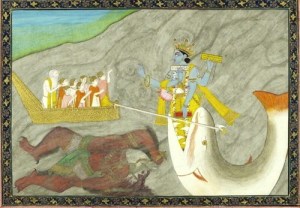
For example, Philomena can tell me the story of Satyavrata – who in ancient Hindu scripture saved mankind from the Great Flood after being advised by God to build a large boat –, just as well as she can tell me the story from the Old Testament about Noah’s Ark.  For her, these are both equally riveting stories (not dissimilar to the flood motif in Greek mythology and across Mayan and Muisca cultures), stories that contain simple messages about the cleansing properties of water and our capacity for spiritual renewal/rebirth. And they are stories of equal merit.

As I stood in church today, I listened hard to the words of the priest and tried not to be too critical. He spoke about Jesus’  final words before he ascended into heaven – to “make disciples of all nations” (Matthew 28:16-20). Like many parts of the gospel, these passages get tricky when taken literally and politicised, and I stood there wondering what was being understood by the audience of (half-listening) 7-year olds.

And this got me remembering that one of the most interesting aspects of what Jesus teaches us is that we should become like a little child – that we should have child-like faith – a faith that’s based completely on trust and doesn’t concern itself with literal truths. A faith that is based on metaphor and the symbolism of stories.

As soon as we walked out of church – after we watched the procession of girls in white dresses walk along the aisle and emerge into the sunshine – I looked over at Philomena and knew exactly what was on her mind.

– “Mami–when can I have my first communion?”

– “…”

And why shouldn’t she be allowed to walk down the Catholic path if she feels inspired to do so? And why shouldn’t I as her parent learn from her unique spiritual journey? Surely, a spiritual journey doesn’t have to be a linear path in one direction, right? Perhaps our children can embark on multiple spiritual paths simultaneously and/or at different periods of their lives?

I just wish I knew all the stories across religions to feel spiritually connected to all of them and versed enough to re-tell them.  So I’ve gone shopping for a bunch of books by Anita Ganeri…


P.S. When I got home and flipped through some of Karen Armstrong’s literature on God, which I always find comforting. In one article she explains: “The conflict with science is symptomatic of a reductive idea of God in the modern West. Ironically, it was the empirical emphasis of modern science that encouraged many to regard God and religious language as fact rather than symbol, thus forcing religion into an overly rational, dogmatic, and alien literalism.”

Read more of her thoughts here and here.


Hierarchy: Mommy can always be the maid. She doesn’t mind.

2 05 2013


Okay so today I will be the Queen and you will be the Princess and tomorrow you can be the Queen and I will be the Princess.

Can Mommy play too?

Yea, she can be the maid.

What about tomorrow? 

Mommy can always be the maid. She doesn’t mind.


MUMMY it’s more fun if I have TWO daddies ’cause if one daddy go to work and one daddy don’t go to work, when I’m sick one can stay with me!

1 05 2013

(6 yr old) Philomena – You know Mummy, today a friend at school said that it isn’t always a man and woman who get married, that sometimes two mummies can get married to each other and have babies as well. But I told her that would be impossible because if two mommies got married together they would have far too many children.

Me – Too many children? 

Philomena – YES! Because they BOTH would want to have babies and they BOTH would be having them at the SAME TIME!!! So they would make TOO many babies to take care of!!!  And then who would take care of the babies???!!! BECAUSE, well, they would both have to work ALL THE TIME to feed the babies! AND BECAUSE, you see, also, there wouldn’t be a daddy in the house to stop them from having all the babies! AND —  

(4 yr old) Luna (interrupting) – If there could be two mommies who are married, could there be two daddy’s who get married as well?

Me – Yes

(6yr old) friend sitting with us – I like having one mommy and one daddy.

Luna (interrupting) – MUMMY it’s more fun if I have TWO daddies ’cause if one daddy go to work and one daddy don’t go to work, when I’m sick one can stay with me!

Philomena – Then I’d like TWO mommies AND two daddies!


Relativity: Question from 4-year-old, Luna

30 04 2013

Mummy, after infinity do we start counting at one again or at zero?


MOTHERS are always bigger than you are – Martin Creed

24 04 2013

mothers


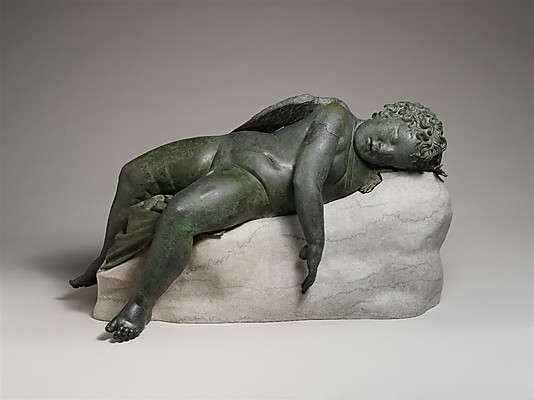
Eros @ the Met

7 04 2013

sleeping eros so i am not quite sure if it was a dream

but i’m pretty sure i made love to the empire state building this past weekend

it was all about LOVE in NY for me and there is nothing better than going to a city wearing a pair of love sunglasses

all i could see was love, everywhere

in every direction

in every gesture

every expression

between that

and the crazy energy of the city (including beloved brooklyn)

the smell of spring

the tequila & mezcal craze that has swept over the city

the fact that little Eros was on display at the Met

the gorgeous mamas i had the privilege of interviewing

it was a serious love-in for which i am extremely grateful:
what is LOVE? what purpose does LOVE serve? what are the types of LOVE that we experience? is LOVE innate? are our children all born with the same capacity for LOVE?  who’s LOVE–what rules of LOVE–do our children abide by? do children come equipped with their own set of rules around LOVE or is everything they understand about LOVE that which they learn from us? how much of our child’s expression of LOVE is inhibited by the props, script and storyline around LOVE that we grown-ups prescribe for them? do we grown-ups adhere to the same rules around LOVE that we teach our children, or do we contradict our own rhetoric? what do our children teach us about our capacity for LOVE? 

a fabulous 4 days

a whirlwind of no sleep

only one long lucid dream

of only love

thank you NY


Visions of Africa

12 03 2013

It was the 26th of December and we were air-bound, on route to the Senegalese Sine Delta with our two daughters (age 4 and age 6) and a group of friends (a total of 9 adults and 9 children, the youngest in the group was just under 2). The plan was to spend a bit of time with friends living in Dakar before driving south along the coastline to a natural reserve.

In addition to soaking up some sun and adventure, our hope was that our girls would come away from this experience with a bit of perspective about the world they live in. That they would form an emotional attachment to new surroundings, new people, new culture and, fingers crossed, the trip would rid them of any pre-existing stereotypes about the African continent already wedged inside their tiny heads.

On the flight over, the girls could not stop giggling and squirming in their seats—their little bottoms swaying from one side to the other, heads flopping in every direction, annoying the passengers seated in front of them by repeatedly opening and closing the latch of their folding table.

What are they going to bring us to eat, Mummy? My 6-year old daughter asks, her face smeared in anxiety.
– You’ll like it, I think it’s a pasta of some sort.  I respond.
–  I want mine plain, please—ok? No sauce, mum, ok? Mummy did you hear me? Please NO sauce!
I imagine it will come with sauce and there is nothing I can do about that. Please remember that this is the only meal you will have for many hours so do your best to eat, otherwise you’ll be very hungry later. 
ANNNND!!! Interjects my just-turned-4 year old, there is NO food in Africa when we get there!  
Of course there will be food in Africa, girls. I say.
No mummy, I know about this. There is no food and there is no water in Africa. The children are hungry there. I learned about it in school. Reconfirms my youngest.

Yes my love, you are right that there are many hungry children in Africa. There many hungry children all over the world—even in London. The problem isn’t that there is no food available though, it’s that some people in the world can’t afford to buy or grow food. We are fortunate because we do have money to buy food in London and we will also be able to buy food in Senegal. Still, it will be a long time till we get to Sengeal, so both of you make sure you eat up your meal when it comes.

– No mummy, you just don’t understand. I REALLY know about Africa.

The food arrives, we open the cutlery and everything smells delicious. The friendly flight attendant offers me a glass of champagne and I decide that I will fly Air France whenever possible as it is the only airline I’ve come across that serves up Champagne to the masses in Economy.

When I look over at the girls, they are staring, eyes wide, at the food before them completely distraught at the sight of a sauce they’ve never seen before.

You will eat. I say sternly and turn back to my own meal.

A good 10 minutes later and 99% of the pasta is still in their dish. I glare at them, eyebrow raised, and the tears begin to well up in my eldest’s eyes. I tried it, Mummy (sniffle sniffle) but I really didn’t like it. I ate the bread and the fruit and I’m full now anyway. I promise I won’t be hungry later.

Few things annoy me (and most people I know) more than wasting food.

Hmmm. Maybe I should throw that starving children argument right back at them. Or better yet, maybe I’ll take them to some Senegalese orphanage when we arrive—then they’ll know what it’s like not to have food–even parents for that matter! Then they’ll know better than to cry over tomato sauce. Spoiled little brats.

As long as you at least try the pasta sauce, I say instead.

I remind them one more time that there is no other meal for the remainder of the trip. The trays are collected and the lovely hostess pours me a cup of coffee.

But no more than 30 minutes go by before the whining begins.

Mummy, I’m hungry.  My tummy hurts. Did you hear me, really Mummy, I’m starving. Mummy, mummy? Please, Mummy, can I have a snack? MUMMMY!!!!

I remind them of what I said earlier and do my best to ignore them. We had already eaten all the snacks I had brought and I really had nothing for them. After nearly an hour of listening to extremely high-pitched whining, the people in front of us, desperate for them to shut up, turn around and hand the girls each a bag of treats.

I admit I was quite relieved.

They stuffed their mouths as if they had never tasted sugar before and instantly began bargaining with one another.

– Can I have some of your Smarties?
No, you have your own treats.
Pleeeeease. I don’t have Smarties in my bag and I know they don’t have Smarties in Africa!

We arrive in Dakar at night. The girls stare out the window of our airport taxi but given the sparse street lighting along the road, there isn’t too much to see.

But then my youngest (her name is Luna) suddenly screams and points her finger upward out the window.

The moon, the moon, my moon—its here! It followed us all the way to Senegal!

The first similarity between Senegal and England is identified.

We share the same moon.

We spend the first day exploring a bit of the city (with the children) and that night we spend dancing till very late at a club (without the children) to an eclectic mix of hiphop-reggae-afrocuban-jazz, alongside stunning long-legged Senegalese women. I was told later that most (if not all) the women in this particular club were prostitutes. I was surprised to learn that prostitution is legal for any woman over 21 who registers with the police and the sex tourism industry apparently goes both ways, with middle-age white women from abroad also engaging with local men for hire.

The second morning we woke to the bluest of skies and the sound of gentle waves rocking the small fishing boats scattered around our beach cove. Our hotel faced the sea but the bustling energy of the city behind our hotel added steadfast rhythm to the beach life.

Dakar

Dakar

It is important to note that the grownups in our group were well aware of the situation unfolding in the Central African Republic and Mali when we arrived and our hosts spent a great deal of time bringing us up to speed on the largely uncovered news of the entire Region.  Surprisingly though, despite overhearing some of our adult conversations and despite the incredibly gruesome images shown on the television in the lounge of our hotel, the children seemed oblivious to the conflicts unfolding in the belt of fire that surrounds Senegal—Mauritania to the north, Mali to the east, Guinea and Guinea-Bissau to the south, and Senegal basically surrounds the Gambia.

Still, I couldn’t help but wonder how a conversation might unfold if by chance the children were to look up from their breakfast croissants piled high with Nutella to notice the bloodshed ravaging above their heads.

What’s happening on the television, Mummy? Is that real? Where is that—is it in Senegal?
Yes, unfortunately it is very real. But no, that isn’t Senegal. In Senegal things are quite peaceful.
­– What’s peaceful?
When people aren’t trying to hurt one another.
— Why are they hurting people in the television?
 

Perhaps the best entry point to a discussion could be to talk about what sets Senegal apart from the other countries—political stability, peaceful social interactions, no sort of extremist religious movements.

What does “extremist” mean?
It’s when you don’t accept that other people have a God that looks slightly different from your God.
— But I thought you said that we can’t see God with our eyes, only with our heart?
— Some people find it difficult to see God with their hearts and rely only on the eyes—eyes are not as wise as the heart.

The kids never asked any questions but I was curious.

I learned that in Senegal religious diversity is an integral part society. Most Senegalese Muslims are Sunni and follow the Sufi religious traditions, which focuses the individual on what the Prophet Mohammed called the greater Jihad—the personal struggle within each of us as human beings for inner peace and reflection. Catholics make up 5% of the population and there are other Christians living side-by-side Muslims in harmony. It doesn’t seem to matter what religious denomination you adhere to in Senegal but what is clear is that everyone must be a believer—atheism is not socially acceptable.

Another factor that may contribute to the peaceful nature of the country is racial equality. Even though Senegal has a diverse set of ethnic groups everyone here is sub-Saharan and dark-skinned. Racial tensions exist in places like Mauritania where the dominant moors, who have their ethnic roots in northern Africa, exclude dark-skinned members of their population and in Mali, where the Berber and north-Saharan populations of the northern Azawad region seek independence from the sub-Saharan government in Bamako.

This is not to say that Senegal has been completely immune to conflict. In the Casamance region of the country a low-level civil war has been going on since 1982 over the question of independence between the government and the Movement of Democratic Forces of Casamance (MFDC). However, this conflict has largely been calmed since the President Macky Sall was elected to office in April 2012. There was also the Mauritania-Sengalese border conflict over grazing rights in the fertile Senegal River valley that began in 1989 and left some 250,000 people displaced on both sides of the border. Between 2008 and 2012, with the help of the UNHCR, most of these refugees have since been repatriated but it is believed that the Mauritanian government took advantage of the repatriation to systematically rid their country of black Mauritanian citizens.

Modern Senegal has always been occupied by various ethnic groups. Some of its kingdoms date back to the 7th century. But unlike neighbouring countries, the empire was built up as a voluntary confederacy of various states rather than an empire built on military conquest and the country has a long tradition of political institutions comparable to that of European states. Léopold Sédar Senghor, Senegal’s first president, was a great intellectual—a poet nominated for a Nobel Prize—who establish a solid democratic foundation and sense of cultural pride. One of his most famous poems begins:

Naked woman, black woman
Clothed with your colour which is life,
With your form which is beauty!
In your shadow I have grown up; the
gentleness of your hands was laid over
my eyes… 
 

Although Sedar Senghor did rule for 20 odd years, he voluntarily stepped down from power and ever since Senegal has enjoyed free elections and peaceful transitions between presidents. There hasn’t been a single coup d-etat in the country’s history.

The following day, we take the children to explore the beautiful little Island of Goree.

Goree

Goree

Goree was one of the first places in Africa to be settled by Europeans and is most known as the location of the House of Slaves, which we visited (without the children).

While our little ones played on the beach carefree, we listened to the curator of the slave museum as he pointed to the “door of no return”—an open door at the far end of the slave quarters with a stunning view over the Atlantic. Apparently, after passing through this door, slaves carrying a weight of 17kilos chained around their neck, either boarded slave ships on route to America or threw themselves into the shark-infested waters below. There is some historical controversy around the exact on-goings of the slave trade in this particular house, but without a doubt the door-of-no-return remains an extraordinary symbol of the horrors of slavery.

As I walked around the claustrophobic quarters, the sound of the curator’s voice echoing inside the walls of torture, I couldn’t help but think of my girls. I wondered whether my 6-year old might already be familiar with the word “slave.” In the United States children begin to learn about slavery at a conceptual level as early as pre-kindergarten (age 4.5) but in the UK they start at around age 9. I also wondered at what age local children on the island understood their history and how this history was explained to them. My heart raced and stomach turned as I tried to consider how I might start to explain it all to mine.

Girls, you know all those children you’re playing with on the beach? Well a long time ago, white people like us, stole their mothers and fathers, locked them up in dungeons with chains around their necks. We packed them as tightly as possible into these small cave-like spaces. We measured their breasts and penises to determine the best price for them because back then we believed big breasts and penises would create better slave-babies. We then took these mothers and fathers and put them on ships to America, where they would continue to live as slaves to the American white people. I know it’s hard to understand, but for some crazy reason we were unable to see that the black people of Africa were just the same as us. I know it’s very sad, but we haven’t always been able to see with our hearts and minds. 

-Mummy, for how long were we unable to see with our hearts and minds?
– I’m sad to say, we were blind for nearly 300 years.

No way. I couldn’t do this. I couldn’t have this conversation yet. I left the museum in a panic. I ran to the beach and comforted myself with a bottle of Coke. Then I watched as my children jumped waves with their friends, in awe of the local boys diving off the nearby dock. The only colour they registered in their mind was the hot pink bougainvillea growing everywhere.

They have bougainvillea in Senegal just like the bougainvillea growing on Omi’s house in Mexico! Second similarity between Senegal and Mexico is identified.

We share the same flowers.

On the third day, we pile into our beat-up Korean Pinto and embark on the five-hour drive along the coast to the Sine Naussean Delta. A caravan of four cars. The traffic chaos leaving Dakar was fabulous (although I was grateful that my husband was driving and happy to be in a car that had already looked as though it had been in a number of minor accidents.)

As we inched—jerked—along the slow-moving highway we grew thirsty but given the multitude of people weaving between the cars on foot, selling fresh fruit (nuts and phone cards) we were able to fill our bellies with juicy oranges. Not one person knocked on our car window to ask for money. People were only eager to sell.

– Mummy, I wish we had people selling fresh oranges in London when we’re stuck in traffic.
– Yes, that would be fun wouldn’t it? 

After 2.5 hours of driving we pull up to a pizza joint. Yes, pizza in Senegal—it does exist. Although, the pizza margarita is a bit spicier in Senegal than in London, our hungry daughters learn how to sip water with every bite. Note that this was the only pizza we ate over the two-week period. The rest of the time the kids ate fresh grilled fish and rice, which they loved.

After the pizza, we turned off the paved road; it had more potholes than the salt flats so we took the off road option. The expanding landscape of sand and salt along our coastal drive, dotted with enormous Baobab trees and white African cows, was something otherworldly. There were a few villages scattered along the way and occasional barefoot, happy children playing in the sand, waving at our girls as they hung out the window.

At one point–maybe a couple of times, our cars got a bit stuck in the sand but we managed to push them out without too much difficulty.

– ­Put some muscle in it, Daddy! Come on!
– Weeeeeeeeeeeee!
– Lets do that again! Let’s get stuck again, Daddy, pleeeease!

Many of the villages we passed along the way contained traditional thatched-roofed homes built in large circles, all facing each other.

– Look girls, what can you tell me about these houses that are different from the houses in England?
– Uhhhhhhhh. Hmmmmmm. I dont know.
– Oh come on, look at the roofs of the houses, what are they made of?
– Straw? We’ve seen that before—they have straw roofs in England.
– What about how the homes are placed all facing each other?
– Yes, just like when we go camping.
– I guess it is.

So no big deal obviously. For every difference I could identify between our two countries, our two continents, the children retorted only with what they found similar or familiar; and if something was ever different, it was only because it was better.

Like the tree house where we slept for the following five nights at our eco-hotel. It was built high up in a Baobab tree, nestled perfectly between three strong branches, each at least a metre in diameter. From the terrace of our magical house, which was literally covered in hot pink and yellow bougainvillea, we had a view of the endless stretch of the Sine Saloum National Park.

– Mummy, why can’t we live in a big tree house in London?
– Believe me, my love, I wish we could live in a tree house sometimes just as much as you do.

 
sine saloum delta

sine saloum delta

Our group of 9 grown ups and 9 children brought in the New Year dancing along side villagers who came to perform at our hotel. The children all loved dancing with us and unlike the grownups, the children had little difficulty getting the rhythm right.

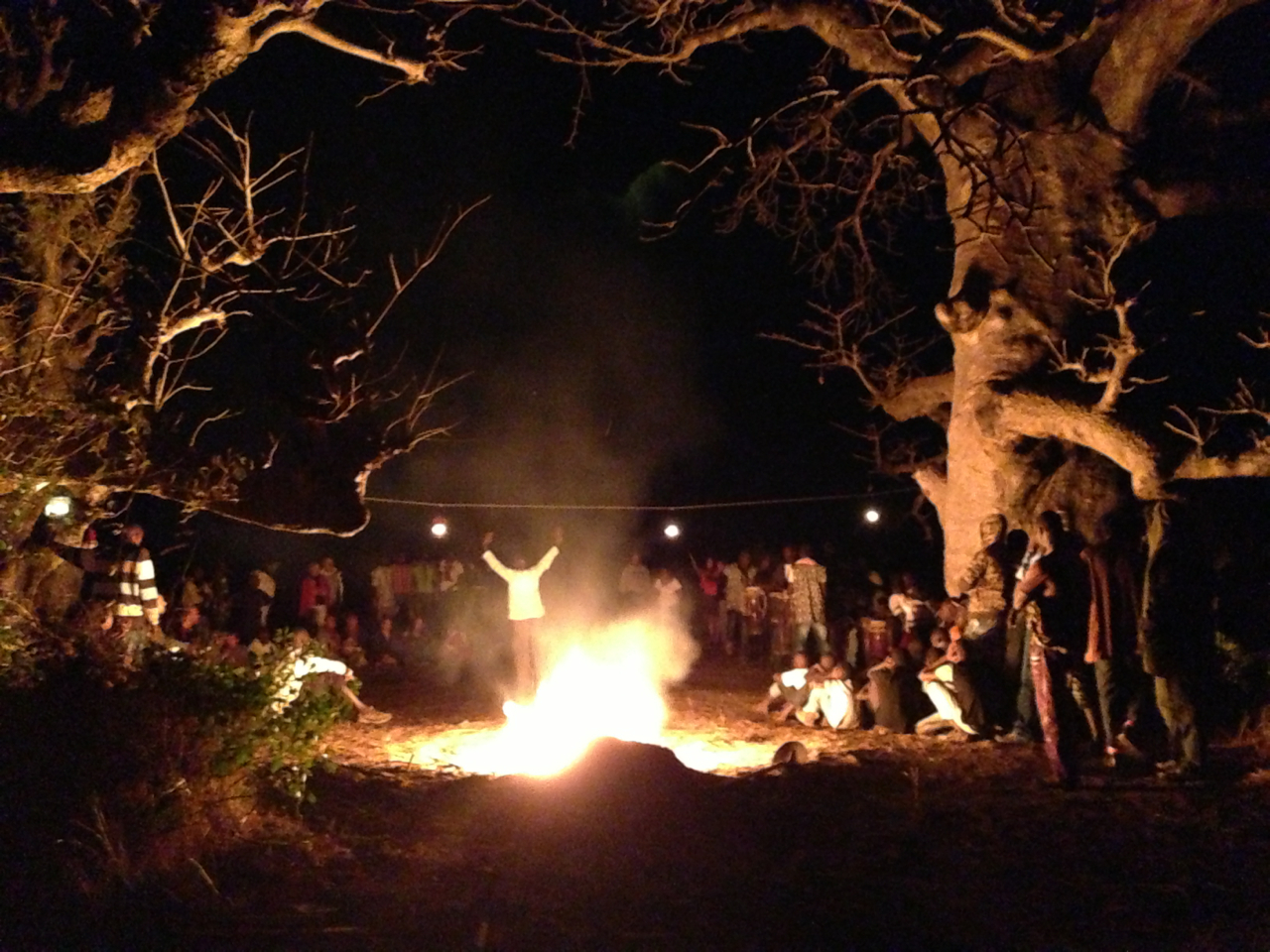
Later that evening, after the little ones were tucked sweetly into bed, some of us ventured off under the moonlight on donkey-drawn carts that took us across the vast delta to a spot where virtually the entire village had gathered around a roaring fire in the middle of two enormous Baobabs. We were there to watch an international wrestling competition (known as Laamb) and one of the villagers was competing against a wrestler from Mali so we had someone to root for. The wrestlers, dressed only in a loincloth, took to battle in the sand with a fury of drumming and chanting all around them. There were occasional outbreaks of uncontrollable dancing among a crowd of around 80 people and even the wrestlers danced between their matches.

senegalese wrestling

senegalese wrestling

It was a magnificent experience and privilege. Did I mention the moon was also out in all its glory?

It was also particularly emotional for me because the 31st of December coincides with the night my husband and I were married. And to my extreme surprise, my husband (who by the end of all the wresting merriment was saturated in the adrenalin) decided to step into the middle of the dancing circle and announce to the entire village that it was our anniversary. This was extremely touching and romantic until the crowd forced us into the dancing ring–at that point my husband and I managed to scare even the wrestlers with our moves.

I am sure that if our daughters had seen the effect that Senegal had on their father that New Years night, they would never had allowed us to leave.

Funny enough, despite the fact that our children didn’t ask us if we could move to Senegal permanently, my husband and I still discussed the possibility.  Prior to moving to London, he and I both spent much of our lives living in the lesser-developed parts of the world, so we would not be unversed in making a life for our selves in such a place. And besides the overwhelming sense of freedom that comes with living in parts of the world where rules are less formal, there is always lots of inspiring work to do.

Speaking of work to do, there was one difference that the children noticed and pointed out to us on our journey across Senegal.  It was the litter in and around virtually all the small towns we visited.

– ­Mummy, why are there so many blue plastic bags everywhere? Why don’t the people just pick up the bags and put them in the bin?
–  Do you see any bins around?
– No. But you would need a LOT of bins for all these plastic bags.
– You are so right. There is a rubbish problem in many African countries, particularly because of the number of plastic bags. The problem is that lots of people here get their clean drinking water in plastic bags. People also use plastic bags to poo in sometimes when there is no bathroom nearby.
-To POO IN!??!!!??
– Well we have toilets in our home in London and when we use them, the pipes carry our waste to a proper place. Not everyone in the world has access to toilets like we do.

2 minutes go by…

– Yes, in London we get our water in plastic bottles but not in bags, right Mummy?
– Yes, you’re right, we do get some of our water in plastic bottles–far too often. We get most of our water from the tap, but we also use far too much plastic. We actually use much more plastic (whether its bags, bottles, wrapping) than they do here in Africa. I guess you could say that we are better at collecting and hiding our rubbish. That’s why you don’t see it as much.
– I’m not a litter-bug, Mummy.
– No, you’re not.

I didn’t tell them that only 10% of rubbish in Africa ever makes it to proper legal dumping areas–90% is left to rot in communities or burned in acrid bonfires. Plastic bags are just a fraction of the overall waste problem but they are nonetheless a serious eyesore against the otherwise serene landscape. Some countries have taken steps to ban and/or tax plastic bags but additional creative solutions to deal with problem are clearly needed.

5 minutes go by…

 – Mummy, how does our rubbish in London get hidden?
(Shit)
– Well actually, lots of our rubbish is sent to China and other parts of the world for recycling.
– Why?
(Shit. Shit.)
– You ask very good questions, my love. The truth is rubbish isn’t just a problem in Africa. It is a problem for everyone in the world.

Nearly 70% of plastics in the UK are shipped to the Far East. About a month prior to our holiday in Senegal I had read an article in the Telegraph explaining how China had actually refused to take in 17 containers of British rubbish (420 tons of plastic) because it was contaminated. Apparently, the Chinese are introducing tougher regulations and now refuse to accept unwashed plastic and unsorted recycling.  I wonder how successful waste management in Europe and the United States would be without China and other Asian countries available to absorb the extraordinary amount of both legal and illegal waste shipments.

Our car ride back to Dakar was bumpy but sunny and filled with great conversation, the kind of conversation that only comes from stepping away from the everydayness of life in London.

We could have stayed another week, or month, or even years, but only if we could carve out the right job. And while there is always a lot to do in places like Senegal there is actually a lot to do everywhere.

The mission of this trip was to broaden our children’s perspective of Africa. Did they build an attachment to a new place, new culture, new people? Absolutely. Are the concerned about poverty in Senegal? NOt in the slightest. As far as they were concerned, every child they played with on the beach was at least as happy as the ones back home.

Did they eat their airplane food on the way home? Of course not.  It still had sauce on it.


God

30 11 2011

P: Mummy, is God a “he” or a “she”?

Mummy: Well, there are many stories about God. In some of them, God is referred to as a Father and in some God is referred to as a Mother.

P: I like to think of God as a “She”.

Mummy: Okay.

P: But you know, the problem is… God doesn’t speak back to me, ever.

Mummy: God doesn’t speak the way you and I do–God speaks through your heart and your mind, not your ears.

P: It’s hard to hear God that way.

Mummy: I know it is, it takes a lot of practice.

P: It’s easier to talk to you than to God actually. You talk back to me when I ask for things.


Fairytales of love

12 01 2011

When I was pregnant I vowed never to show my children certain films or read them certain fables—Snow White, Cinderella and Sleeping Beauty were at the top of that list. This was simply because I never wanted them to overly romanticise love, marriage, or consider waiting “forever” for some prince to come rescue them. I also was extremely uncomfortable with the fact that all of these tales featured dead mothers and wicked step-mothers (I have recently learned that the second part of the non-Disneyfied version of Sleeping Beauty actually features a cannibalistic mother-in-law who attempts to eat all of Sleeping Beauty’s children—as if she hadn’t suffered enough from her 100 year coma!)

Still, by the time Philomena had turned 4, she had the three book versions of the stories above and had seen Sleeping Beauty a dozen times over (actually, I am embarrassed to confess just how many times she’s seen the film). So while I didn’t appreciate the lesson being taught by the fable, i.e. that with patience and through passivity, every woman’s prince would come to her rescue and marry her, or that a woman is somehow incomplete without a man, or that a woman should not dare to be curious (curiosity, represented by the spindle in which S.B. pricks her finger, led to her terrible fate), I still exposed her to it in all its glory. Upon lots of pleading, I even bought her a Sleeping Beauty dress and matching crown.

Anyway, as you might suspect, P has taken to love this story so much that we re-enact it regularly at home.

One day, P was so set on the idea that her father would play the role of “prince,” despite the fact that he had not yet come home from the office, that she lay herself down on the floor of our kitchen for 30 minutes (I kid you not!) and patiently waited until her father came home to waken her with a magic kiss. Dressed in her Sleeping Beauty gown, a pillow under her head and hands folded over her belly, she perched her lips and just waited and waited and waited for what probably felt like 100 years to her little 4 year-old self.

I tried everything to convince her to get up off the floor (it was late, we needed to eat, have a bath and get to sleep) but  she refused to EVER get up until the prince arrived. I was, of course, incredibly relieved when he finally walked through the door.

And even more overjoyed that he knew to kiss her immediately. With a gleaming smile from ear to ear, Philomena stretched out her arms to greet him and quickly pronounced them “married.” Moments later, she led her prince down the make-believe grand staircase of her castle to dance the waltz, which she hummed as loudly as possible. I, in the role of her mother, the Queen, was commanded to cry with happiness while watching them dance.

It was just about the sweetest thing in the world to observe my 4-year old wait so patiently to be kissed, held and danced with by her father-prince. But I was also unsettled by the fact that we were all celebrating the fact that my child was being influenced by 16th century values, passed down in story form by peasants around a campfire 4 centuries ago, knowing full well that these violent stories were embraced at a time when society was extremely sexually-repressed and dominated by religious conflict.

A while back I read ‘The Uses of Enchantment’ by Bruno Bettelheim to get a better understanding of the value of such fairy tales–it was actually the reading of this book that made me lighten up a bit about exposing my children to all these old methods of story telling. Bettelheim won the US Critic’s Choice Prize (1976) and the National Book Award for Contemporary Thought (1977) for his analysis and support of these fairy tales, which he believed ultimately helped children to deal with their own inner darkness, fear of abandonment and sense of purpose–his logic was framed in terms of Freudian psychology. All in all, what I took away most from Bettelheim’s book was his message that a parent should not to alter or offer explanations of the plot or characters of the fables. He believed that children would come away after each reading of the fable with a deeper understanding of them; to soften or alter the stories could potentially cause more confusion and harm to the child.

Charles Perrault, who first published ‘The Sleeping Beauty in the Wood’ in 1697, made some changes to the century old fable to appeal to the aristocracy of Louis XIV by making the characters more opulent, but he made sure to leave  the original fable to speak for itself. Well I read Perrault’s story today and was amazed to discover that I had been completely wrong about my understanding of the story. It was actually good old Walt Disney, who altered the fable in the 50s, pumping some 6 million dollars into its adaptation, which was VERY different from the original story, as an attempt to expel his own Christian narrative and patriarchal values.

How ironic is it that I find the original fable easier to embrace than the one updated in the 1950s—the version embraced by my parents generation?!  How ironic is it that those 16th Century peasants weren’t nearly as sexually repressed as Disney?!

Perrault’s original text  actually tells a story of a prince, who waited 100 years for the love of a princess. It tells of an extremely devoted and emotional man who was “more at a loss than she.”  It tells a story of a marriage sealed in secret, unbeknownst to the King and Queen, and of sleepless nights of divine love-making. It tells the story of a son afraid of his strong and powerful mother who eventually begins to suspect that he is married and reacts with jealousy and vengeance.  Lastly, it tells the story of a humble servant who stands up to the angry Queen to protect the love between the prince, the princess and their children.

This is much more my kind of story.

See for yourself below:

“At last he came into a chamber all gilded with gold, where he saw upon a bed, the curtains of which were all open, the finest sight was ever beheld — a princess, who appeared to be about fifteen or sixteen years of age, and whose bright and, in a manner, resplendent beauty, had somewhat in it divine. He approached with trembling and admiration, and fell down before her upon his knees. And now, as the enchantment was at an end, the princess awaked, and looking on him with eyes more tender than the first view might seem to admit of. “Is it you, my prince?” said she to him. “You have waited a long while.” The prince, charmed with these words, and much more with the manner in which they were spoken, knew not how to show his joy and gratitude; he assured her that he loved her better than he did himself; their discourse was not well connected, they did weep more than talk, little eloquence, a great deal of love. He was more at a loss than she.”

…after supper, without losing any time, the lord almoner married them in the chapel of the castle, and the chief lady of honor drew the curtains. They had but very little sleep.

…the prince left her next morning to return to the city, where his father must needs have been in pain for him. The prince told him that he lost his way in the forest as he was hunting.

The king, his father, who was a good man, believed him; but his mother could not be persuaded it was true; and she began to suspect that he was married…

The queen spoke several times to her son, to inform herself after what manner he did pass his time, and that in this he ought in duty to satisfy her. But he never dared to trust her with his secret; he feared her, though he loved her, for she was of the race of the ogres, and the king would never have married her had it not been for her vast riches; it was even whispered about the court that she had ogreish inclinations, and that, whenever she saw little children passing by, she had all the difficulty in the world to avoid falling upon them. And so the prince would never tell her one word.

But when the king was dead, which happened about two years afterward, and he saw himself lord and master, he openly declared his marriage; and he went in great ceremony to conduct his queen to the palace. They made a magnificent entry into the capital city, she riding between her two children….

for the complete story see: http://www.pitt.edu/~dash/type0410.html#nights


Hierarchy & Governance

7 01 2011

Philomena (4) in conversation w Luna (2):

P- You know, Luna, Mami is the boss. Then comes Papi but Papi says they are both the boss.
L- Yea.
P- When they go out, Mama-miel and Papa-miel (the grandparents) are the boss.
P- When none of them are home and the baby-sitter is here, well then she takes care of me and I take care of you. But I am the boss really. I am the boss. Okay Luna? I am the boss then. You understand that luna? Luna, Luna are you listening? LUNA I’M THE BOSS THEN OK?!
L- NO, MENA!! NNNNNO!!!!!


Heaven

6 01 2011

A conversation between P and her granny, Mama-miel:

P- Where is your mummy?

M- She lives in heaven.

P- That’s a long way away, heaven.

M- Yes.

P- I haven’t been there yet.

M- I haven’t either.


Jesus is dead!?

19 12 2010

It is 5 days before xmas. P is 4 years and 1 month. We are taking a cab home after seeing a live filming of the Bolshoi Ballet’s Nutcracker at the Gate cinema in Notting Hill.

P asks me:

– Who’s birthday is coming up next?

– Jesus’s birthday.

– Baby Jesus’s birthday?

– Yes. On Christmas Eve we celebrate Jesus’ birthday. Its a birthday party where we all get presents and give presents for being good like Jesus was.

– But I don’t know Jesus? Can we go see Jesus at Jesus’ house?

– Well sort of, we can go see Jesus at church? We will go to church on Christmas Eve.

– At church? What’s church?

– Its a special house where we celebrate Jesus’ life and Jesus’s magic.

– Jesus’ magic?

– Yes, Jesus had magic because he was so good.

– Can I see Jesus?

– No, but you can imagine Jesus.

– But I want to see Jesus. Where is he?

– Well he died a very long time ago.

– He died???!!!! Why did he die???!!!

– Because it was his time to die. But he is in heaven now with all the angels, high up in the sky, dancing and flying around the clouds, looking down on us to make sure that we are all okay.

– His time to die? Did he fall and hurt himself and die? Where did her die, mummy?

– No he didn’t fall. He died on a cross.

– A cross? Like an “X”?

– Yes, but I will tell you all about how he died another day. What is most important is how he lived, because he was a very special person who only wanted to give, to make other people happy, to teach people not to fight, to teach people to share and be kind to one another. This gave him special powers–he was so good that he could make sick people feel better and-

– Could he make dying people be alive?

– Yes, I suppose he could sometimes.

– Because he had magic? because he was good?

– Yes, I suppose.

– Will I die like Jesus? Because I am good, mummy. Will I die?

– Yes, everyone dies one day.

– When?

– We don’t know exactly when we will die, but it wont be for a long time I imagine. And we all have magic when we die, that’s when we get to fly up in the sky like angels.

– Oh.
Cab pulls over. We get out. She is quiet and I am worried that she might be scared, that I might have said something wrong.

– Are you scared, P?

– No. Look Mami, its the moon! Its not a half moon–it’s a whole moon!
The moon was amazing, perfectly round in a clear sky and there was snow all around us.